


There was a time when testing a new customer experience often meant assembling eight or 10 consumers in a room, putting snacks on the table and asking questions while executives watched from behind a one-way mirror.
Focus groups became particularly visible during the 1990s, when renewed interest in qualitative research helped fuel a resurgence of the method. A 1996 review in the Annual Review of Sociology described focus groups as having reemerged during the previous decade as a popular way to collect qualitative data. Research literature from the period also shows the technique spreading across marketing, communications and other fields.
The basic idea remains remarkably relevant for franchise brands in 2026: Before assuming customers will like something new, ask them.
What has changed is where, when and how that conversation happens.
A franchise system no longer needs to limit customer research to a conference room. Brands can test an app, ordering process, loyalty feature, menu concept or service change while customers are actually using it. In some cases, they can turn participation into another reason those customers return.
Domino’s is doing exactly that.
Turning a Digital Rollout Into a Customer Test
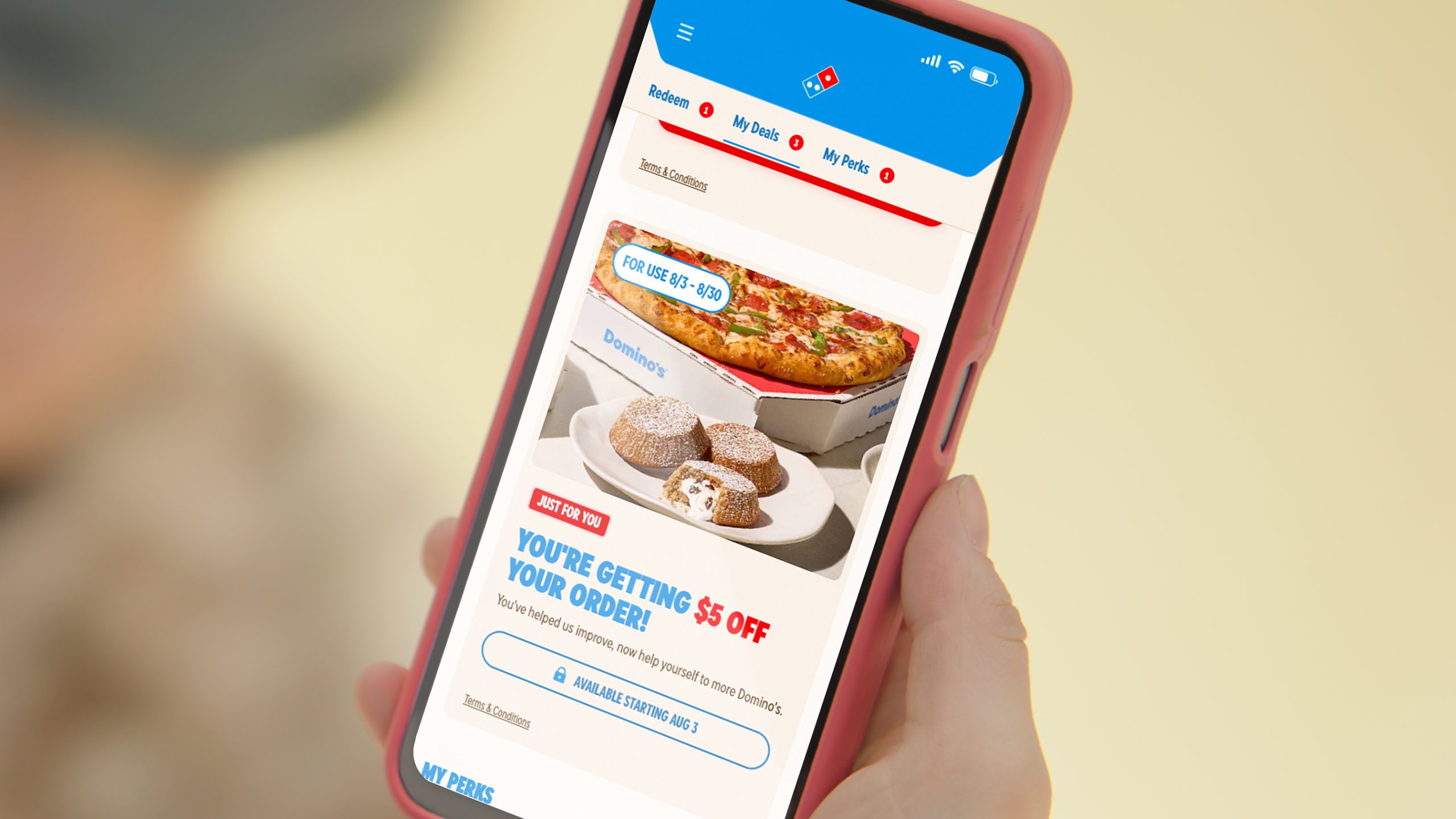
Domino’s Pizza announced on August 3rd that it would effectively pay customers to try its redesigned website and mobile app through a limited-time $5 bounce-back offer.
Customers who place a qualifying digital order between August 3rd and 30th are eligible to receive $5 off a digital order the following week. Domino’s Rewards members receive the coupon through “My Deals,” while other eligible customers receive it by email.
The promotion follows a redesign of the company’s website and app earlier this year.
“We streamlined our website and app to make them bolder, brighter, more modern, and engaging for customers, but we want to hear from them,” said Mark Messing, Domino’s vice president of global digital marketing.
After completing an online order, customers have an opportunity to provide feedback about the ordering experience. Importantly, Domino’s does not require customers to submit feedback to qualify for the coupon. That distinction makes the campaign interesting beyond the discount itself. The company is combining several familiar business tools into one customer experience: a digital product launch, customer research, a promotional incentive and a reason for another purchase.
For franchise brands, that combination deserves attention.
Domino’s operates more than 22,500 stores across more than 90 markets. Independent franchise owners accounted for 99% of its stores at the end of the second quarter of 2026. Digital ordering also carries considerable weight in its U.S. business; more than 85% of U.S. retail sales in 2025 came through digital channels, according to the company.
When that much customer traffic moves through an app or website, improving the digital experience is not simply a technology project. It touches franchisees, operations, marketing, loyalty and the customer relationship.
Focus Groups Did Not Disappear, They Evolved
The traditional focus group has a much longer history than its 1990s cultural heyday might suggest.
Group interviewing appeared in research during the early 20th century. In the 1940s, researchers including Robert Merton used “focused interviews” to study reactions to radio programming and military training and morale films. The technique subsequently became closely associated with market research.
By the 1990s, focus groups were enjoying another period of strong interest. Research books and professional literature proliferated, and a 1994 trade article described focus groups as one of the popular and fast-growing market research techniques of the period.
They have not vanished in the internet era either.
Greenbook’s 2025 GRIT Insights Practice Report found that in-person focus groups and in-depth interviews remained among the three most-used methodologies across nearly every segment it surveyed. Online qualitative research, webcam interviews, and research communities have joined the mix, giving companies more ways to listen to customers without abandoning traditional qualitative research.
The bigger change is therefore not the death of the focus group. It is the expansion of the testing toolbox.
Companies can now combine moderated conversations with online communities, surveys, usability testing, customer behavior data and controlled digital experiments. The growth of internet businesses beginning in the late 1990s also created the opportunity to run experiments with customers at a scale that traditional research rooms could not easily match.
For a franchise organization, that opens another possibility: the customer experience itself can become the research environment.
A Test, Learn and Reward Model for Franchise Brands
Domino’s approach illustrates a simple framework that could apply well beyond pizza: test, learn and reward.
Test: Introduce a new customer-facing feature to real customers instead of relying exclusively on internal opinions.
Learn: Make it easy for customers to explain what worked, where they struggled, and what they would change.
Reward: Give participants something meaningful enough to recognize their time while potentially encouraging another visit or purchase.
Research incentives themselves are well established. User Interviews, a research participant recruitment platform, analyzed nearly 20,000 moderated and unmoderated research projects for its 2025 report on participant incentives, noting the role compensation can play in recruiting participants.
For franchises, however, the reward does not necessarily have to look like conventional research compensation.
It could be loyalty points for trying a new ordering feature. A restaurant might offer a future discount after customers test a redesigned pickup process. A fitness franchise could invite members to test a scheduling tool. A home-services brand might ask customers to evaluate appointment notifications. A retail franchise could allow loyalty members early access to a new digital feature.
The opportunity is to connect customer research with actual customer behavior.
There is also an important discipline behind the idea. Not every promotion qualifies as meaningful research. Brands still need to determine what they are trying to learn, which customers they need to hear from, and how feedback will influence a decision.
Listening only to enthusiastic loyalty members, for example, may produce different insights than observing first-time customers. A large number of comments does not automatically make research representative. The technology may be newer, but some of the principles behind the old focus-group room still apply: ask a clear question, listen carefully and avoid assuming the loudest opinion represents everyone.
Franchise Systems Have a Built-In Testing Network
Franchise brands may have another advantage when experimenting with customer experiences: their systems naturally contain different markets, operators and customer populations.
A brand considering a new ordering process, menu format, loyalty feature or service model can potentially test it in a limited number of locations before committing the entire system.
Digital tools add another layer. Brands can observe whether customers complete an order, abandon a process, redeem an offer, or return after interacting with a feature. Qualitative feedback can then help explain the behavior behind those numbers.
That combination can be more informative than asking only whether someone “likes” an idea.
The franchisee also belongs in the learning loop. A customer-facing improvement that creates operational complications at the unit level may need additional work. Conversely, franchisees may identify customer friction that does not appear in dashboards or corporate research.
The strongest experiments can therefore listen in several directions at once: customer feedback, behavioral data, and franchisee experience.
The Modern Focus Group May Be the Customer Journey
The focus group room is not obsolete. Current research suggests companies continue to use it, both in person and online. But brands now have something researchers of previous decades did not: the ability to invite customers into a live experience, watch how they interact with it, ask what they think, and potentially reward them for participating. Domino’s latest promotion offers one version of that idea.
For franchise brands, the broader lesson is less about pizza or a $5 coupon and more about treating customers as participants in the improvement process.
Instead of developing every new experience behind closed doors and unveiling it as a finished product, a brand can create a cycle of testing, listening and refining. The one-way mirror may have given way to the smartphone screen, but the question behind it remains familiar: What does the customer think? Today, franchise brands have more ways than ever to find out.
