


In 2005, three years after opening Dogtopia, Amy Nichols was preparing to franchise a business model many people had never encountered. Dogtopia had one location with a second on the way, and dog daycare was still an unfamiliar concept for most people exploring franchise ownership. Nichols knew prospects would arrive with assumptions about what the business was, and many of those assumptions would be wrong. She saw the Franchise Disclosure Document as the place to replace guesswork with a clear picture of what a buyer would actually be getting.
That instinct shaped the next two decades of her career. To Nichols, an FDD does more than satisfy a legal requirement. Used well, it helps a buyer understand exactly what they are committing to, and that understanding influences everything that follows, from the first conversation through the life of the franchise relationship. “Better understanding is going to lead to a better decision,” she said.
That belief now sits at the center of Clearly FDD, the platform Nichols built to make franchise disclosure documents readable, searchable, and neutral. In a conversation with Franchise Brief, she summed up the philosophy behind it in a single sentence.
“I think of the FDD as the source of truth in franchising.”
A Franchisor’s Education, One Lesson at a Time
From the time Nichols began franchising Dogtopia in 2005 until her exit in 2015, much of her work doubled as an education in franchising itself. Each year taught her something new about what an FDD could hold. Early on, she had no idea a franchisor could spell out grand opening requirements or have a technology fee that encompasses tools to better the system. Questions about minimum royalties, flat fees, and ad fund disclosures had no easy reference point either. She had a great attorney, but no simple way to see how comparable brands presented the same information, and as she puts it, “there’s no class on that.”
With hindsight, she believes her core numbers, like the royalty percentage, would have landed in the same place. What would have changed is how clearly she explained things from the start, and how many revisions the document needed later. She also noticed her own motivations shifting. A love of dogs brought her into the business, but something else kept her there. “It’s really about being a franchisor and being a franchise company,” she said.
That realization pulled her deeper into the franchise community, including active involvement with the IFA and the CFE process. It also reinforced what a friend once described as her “justice gene,” a belief that you do things the right way because it is the right way, and because it serves other people best. Her years supporting franchisees put that belief to work. Many early Dogtopia owners loved dogs so much that they worked in their businesses from 7 AM to 7 PM, and Nichols often had to convince them that a general manager was an investment, not an expense.
She also learned that optimism is part of every franchise sale. Every prospect, she notes, expects to beat the average revenue figure in Item 19, because everyone assumes they are above average. Her response was to set expectations early and honestly, even when the message was harder to hear. “I’d rather be realistic in the beginning,” she said.
When “That’s Not What You Told Me” Becomes a Legal Matter
After Dogtopia, Nichols spent time in animal welfare and led GoodFriend, a platform developed at Kinship, a division of Mars Petcare, to connect pet care professionals with pet parents. She later drafted a new FDD for an emerging brand after returning to consulting. Rounding out her executive profile, Nichols served as CEO of Pet Supermarket, a chain of about 200 locations, most of them in Florida. Across the industry, at events and in conversations with other franchise professionals, she has heard and seen the same story play out again and again. A new franchisee signs with excitement, hits the inevitable bumps in the road, and comes back saying, “but that’s not what you told me,” or “that’s not what the agreement says.”
Often, the franchisor can point to the exact page where the detail was disclosed. That hardly settles things, because the relationship has already taken damage. Whether the franchisor ends up explaining, correcting, or quietly pointing out that the franchisee should have read more carefully, confidence erodes on both sides. “That just erodes trust,” Nichols said.
She wanted to know how often those breakdowns escalate, and she had the data to find out. Her analysis of the 2,000 brands in the Clearly FDD database found that 52.2% disclosed at least one legal matter. Franchisees sue franchisors more often than the reverse, and alleged sales misrepresentation was the top category, at 28% of those lawsuits. Nichols adds important context: brands that have been around longer and have more units naturally face higher odds of litigation. She also points out that disclosed lawsuits are only part of the picture, since arbitration and negotiated disputes rarely appear in an FDD at all.
For the franchisee, the stakes extend well beyond a disappointing return. A personal guarantee on an SBA loan can put a family’s home at risk. “It’s more than money, right? It’s your life,” Nichols said. Across her database, the average investment is over $200,000, yet many prospects never spend a few hundred dollars on diligence.
Around the time she was building an early version of her product, Nichols found that the IFA had been advancing a Responsible Franchising initiative. As she reads it, two of its top priorities are improving pre-sale transparency and making FDD information more comprehensible and useful to prospective franchisees. That matched her view that disclosure should be something a franchisor uses to help a prospect understand the business, not a formality to get through. “It really should be a tool of understanding, not a hindrance,” she said.
From there, the realization became simple. Marketing materials, websites, and sales conversations vary from brand to brand, but every franchisor must produce the same 23 items. That document is also what the franchisee ultimately commits to when signing the franchise agreement. In Nichols’s words, “everybody has to have 23 items in their FDD. And that’s what we should be looking at and comparing and measuring.”
Built First for the Person About to Sign
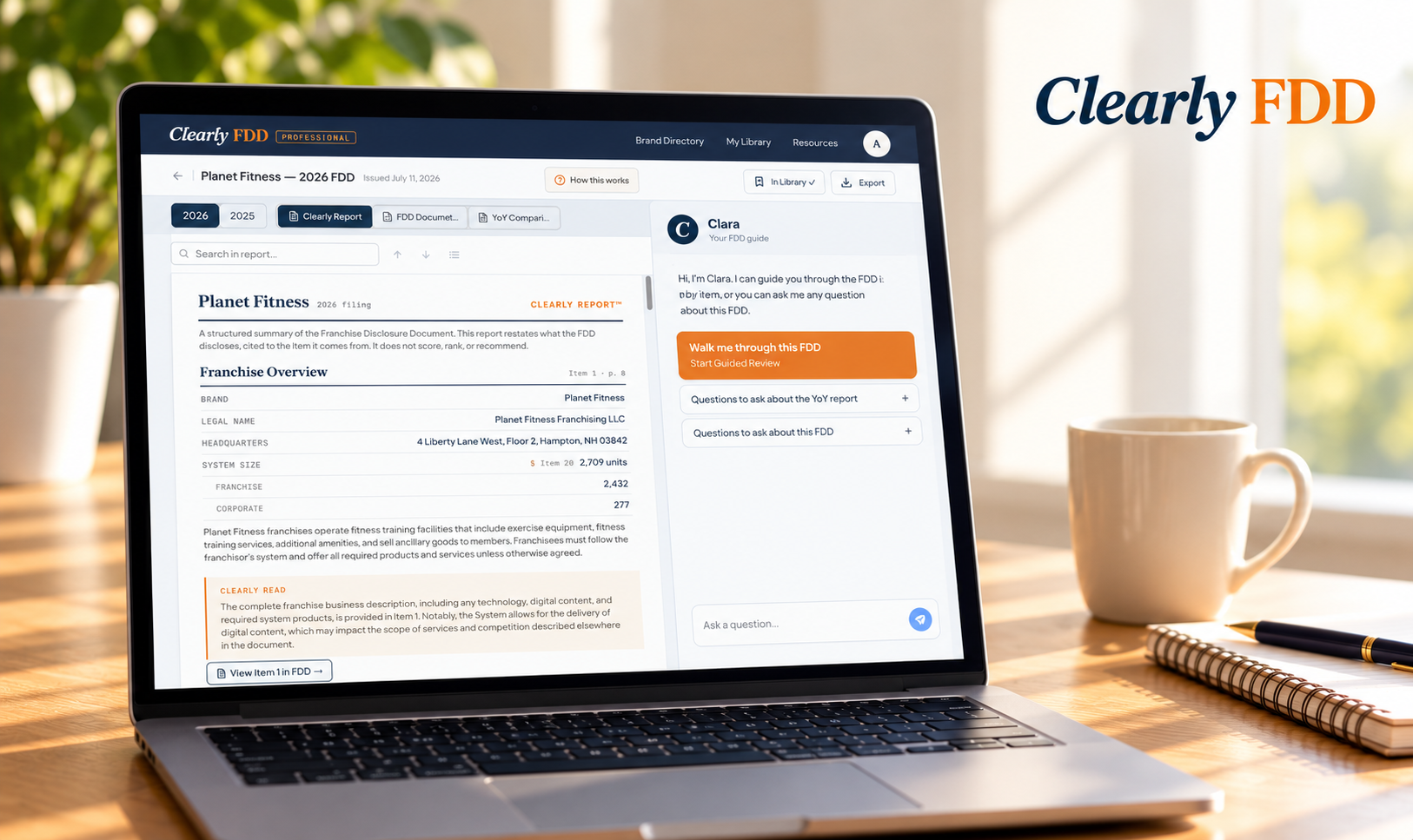
Clearly FDD’s first audience was the prospective franchisee, especially someone new to franchising. Every brand in the system starts with a Clearly Report, which pulls data from eight key FDD items (royalty, initial investment, and Item 19 when a brand provides one) and presents it in plain English. Anyone who has worked on an FDD understands the value, since the document is known for its unique and creative tables, which can make critical information hard to find and harder to interpret.
Alongside the report sits Clara, an AI guide who can answer questions about that specific FDD. A prospect might ask what it means that a territory is protected but not guaranteed. Clara can explain that the franchisor may be able to place a location in that territory based on its own metrics, or divide it if minimum revenue isn’t met. Clara brings general franchise and business knowledge, but her answers about a brand are grounded in that brand’s FDD, with no access to outside sources.
Just as important, every answer and every data point in the report cites the underlying FDD, so users can verify what they read. A response about territory might carry a reference to Item 12, page 54, and one click takes the user to the exact wording. That habit comes from her years of drafting FDDs, where precise language matters. She also recognized that a report alone would only help people who already knew what to look for. “They’re not going to know what to ask,” she said of many first-time buyers.
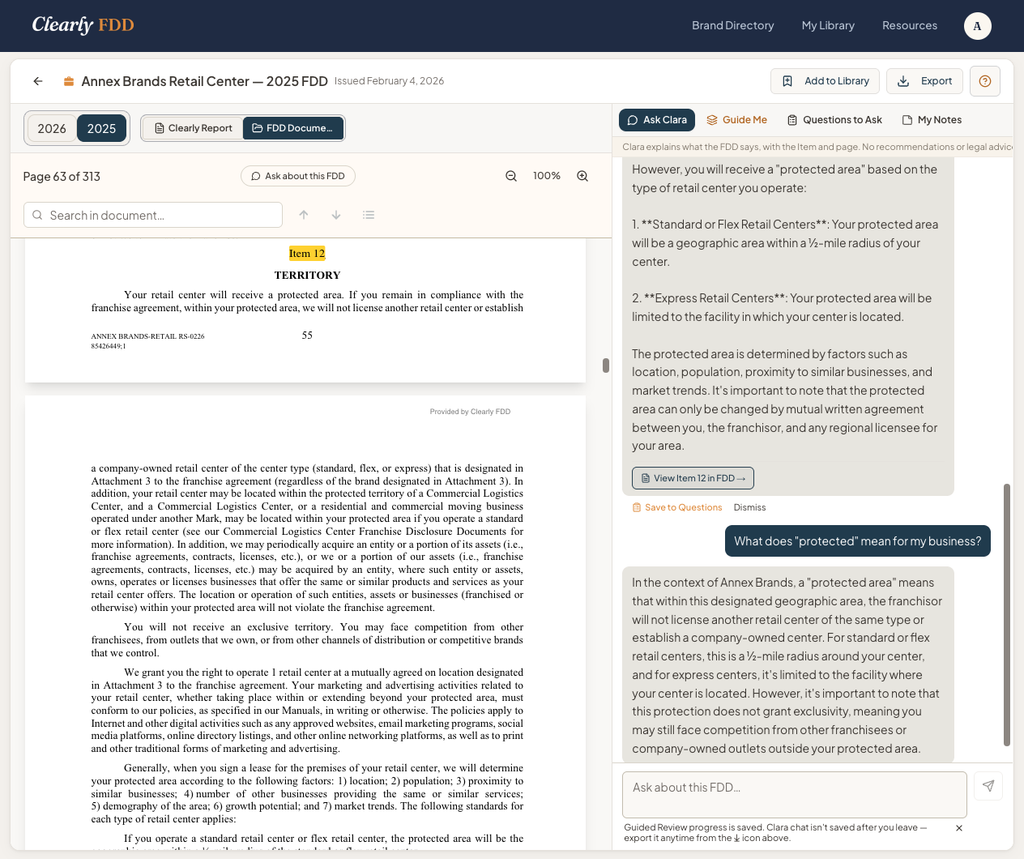
That insight led to the Guide Me feature, which walks users through every item in the FDD. It explains what each item covers and why it matters, and suggests follow-up questions, such as whether the franchisor’s owner also owns other franchise brands. Users can skip around, pause on the items that matter most to them, or stop at any point to ask Clara for clarification.
A Guide That Doesn’t Judge
Neutrality is the heart of the product. Clearly FDD doesn’t rank brands as best or worst, and it doesn’t label anything risky or safe. It reports what the FDD says and leaves the judgment to the reader. “It’s called CLEAR for a reason,” Nichols said.
That neutrality also takes pressure off the learning process. Talking to a franchisor, consultant, or attorney can feel intimidating when a prospect thinks they should already understand a weekly minimum fee or a nine-month deadline to secure a location. With Clara, there’s no one to impress, and in Nichols’s words, “You can ask her the dumb questions.” Clearly FDD doesn’t track those conversations either, so whatever a user asks “is between them and Clara.”
Clara is also multilingual. A prospect can ask a question in Spanish or Gujarati, for example, and she will answer in that language, explaining the FDD without translating the document itself. For many buyers, even fluent English speakers, legal terminology is a language of its own, and that option can make a complex commitment far easier to grasp.
Why This Couldn’t Have Existed Two Years Ago
Nichols’s comfort with technology goes back further than her franchise career. Out of college, she worked at Verizon and then Cable & Wireless, where she sold web hosting. At Dogtopia, she worked on a new POS system because off-the-shelf options didn’t fit the brand’s operating procedures. At Kinship, she represented the business side of GoodFriend for about three years and worked closely with product managers and engineers.
Still, she is quick to say she isn’t a software engineer. She understands what’s possible and what good UI and UX look like, but the product only became feasible because the tools changed. “I could not have built Clearly a year ago, definitely not 2 years ago,” she said. Until recently, a platform like this would have required a substantial engineering team.
Today, Nichols has a different kind of staff. “I like to say I have employees ’cause I have 8 different agents that do different things for me in my work with Clearly,” she joked. The FDD turned out to be an ideal subject for this kind of technology, because while the writing varies, the structure doesn’t. As she explains it, “while it’s super complex, it’s also consistent.”
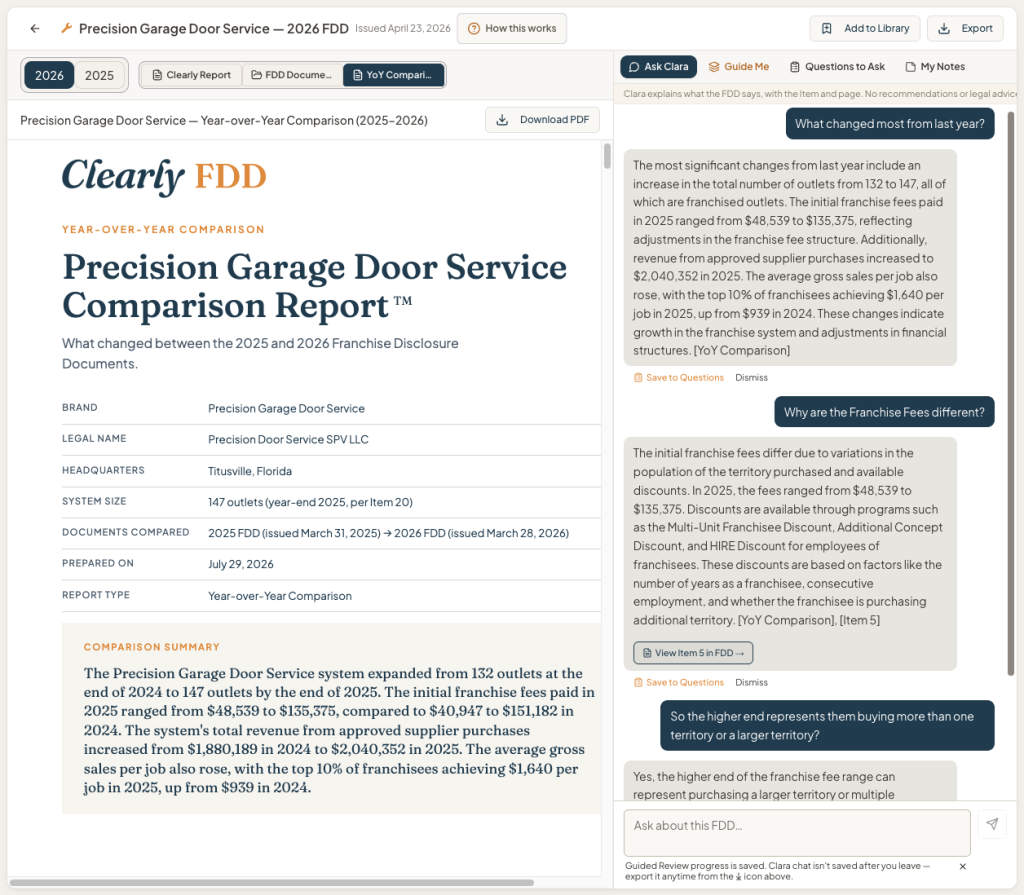
Clearly FDD ingests and parses each document in full and generates its reports automatically. The database now includes nearly 2,000 franchise brands and more than 2,800 parsed FDDs across multiple years. The growing archive powers year-over-year comparisons that she finds especially revealing, calling it “super interesting to look at what changed between the years.”
When Prospects Ask a Chatbot First
Technology is also creating a new challenge in franchise sales. Prospects comfortable with ChatGPT, Claude, or Gemini may upload an FDD or simply ask a chatbot what it knows about a brand. In Nichols’s view, those general tools have no guardrails tied to the document, so a prospect may receive 2023 figures presented as current, with the source buried where no one thinks to look.
As a result, franchise development teams increasingly have to undo misinformation before they can share accurate information, a harder conversation than starting fresh. Clearly FDD offers a closed-garden alternative. Prospects can ask Clara the same questions they would ask any chatbot, but her answers are grounded in the brand’s own FDD, with citations that let them check the source.
One Source of Truth, Many Seats at the Table
Parsing more than 2,800 FDDs did more than power a consumer tool. It created a data set that professionals across the industry can put to work, and Clearly Professional gives brokers, consultants, and franchisors access to it. For a consultant or franchise sales organization representing hundreds of brands, it works as a resource library. They can review the brands they represent, research competing brands a client is considering, or study an entire category. A built-in comparison tool lines up brands side by side (three pet services brands, for example) and produces a downloadable report to share with a client.
Nichols also sees the platform as a way for consultants to stay useful between calls. Rather than leaving prospects to piece together information online, a consultant can hand them a structured, accurate place to work through an FDD and record their questions. In a field where many consulting groups look alike from the outside, she believes that kind of tool could become “a huge differentiator.”
Franchisors stand to gain in a different way. Prospects who work through an FDD with Clara can learn what the document says about existing locations, territories, fees, and obligations before they ever sit down with the development team. They arrive at Discovery Day and validation prepared, ready to ask thoughtful, brand-specific questions rather than basic ones like what a protected territory means. Because Clara’s answers are grounded in the franchisor’s own FDD and cite the underlying document, prospects can verify what they learn, and the information stays current even when an operations team member hasn’t caught every change between FDD years. That leaves more time for the conversations that help both sides decide whether the fit is right.
Nichols also sees room for private versions of the platform. A consulting group representing a few hundred brands, or a multi-brand franchise company, could offer prospects a version limited to its own portfolio. Internally, legal teams could study how comparable businesses present similar disclosures. Marketing teams could see exactly how their investment levels, royalties, or minimum fees compare with competitors’.
Suppliers are a third audience. Using a reporting module now in beta, Nichols shared an example of building targeted lists from FDD data. For one supplier, she identified franchise brands with more than 50 units that had grand opening marketing requirements, limited to East Coast-based service businesses, with each brand’s required spending detailed.
Next on the roadmap is Clearly Decide, a consumer tool for narrowing a shortlist. Prospects will be able to compare multiple brands, rate them, and organize their research in one place. The guided experience also helps users sort their remaining questions into three groups: questions for the franchisor, questions for current franchisees during validation, and questions for an advisor or attorney. Throughout, Clearly FDD stays a sales-free zone. It doesn’t share leads with franchisors, and entering an email address doesn’t trigger a flood of franchise offers. “Clearly doesn’t make money if someone buys or doesn’t buy,” Nichols said.
Pricing Designed to Remove the Barrier
Clearly FDD launched at $99 per brand, a price Nichols set with the legal value of understanding an FDD in mind. She soon ran into a practical problem: most prospects don’t know they need this kind of help. They come to franchising as optimists, rarely aware of how often disputes arise. “I didn’t want to have barriers there,” she said.
She lowered the consumer price to $19 for a single brand workspace, a level meant to feel like an easy decision for anyone considering a few brands. Access doesn’t expire, since many prospects look at a brand and return six months or a year later. The workspace, the Clearly Report, and Clara all stay available, and users can download their materials anytime. So far, the lower price point has increased consumer purchases. Against an average investment of over $200,000, it’s a small price for knowing what you’re signing.
Clearly Professional costs $199 per month, with an introductory rate of $149 per month. Subscribers can access any of the nearly 2,000 brand workspaces, along with multi-year data, year-over-year comparisons, downloadable Clearly Reports, and side-by-side comparison reports for clients.
Leveling the Playing Field
Conversations with franchise attorneys have strengthened Nichols’s conviction. One attorney, whose work focuses mostly with franchisees after they have signed, told her that earlier understanding could have spared many of his clients serious pain. Relaying his reaction, she recalled him saying that if they had used a tool like hers before signing, “they’d save so much heartache, grief, money and stress.”
At its core, her motivation comes back to a simple imbalance. Whoever drafts an agreement understands it best. “The person or company that writes the contract, that writes the agreement, automatically has the advantage,” Nichols said. Clearly FDD doesn’t try to tip that balance toward either side. Instead, it aims to “help level that playing field a little by helping with understanding.”
Two decades after she first used an FDD to give buyers a transparent view of a business model they had never seen before, Nichols is still betting on the same principle. Clear information leads to better decisions, and better decisions build stronger franchise relationships. As she puts it, “My hope is that people will believe in transparency and having things be clear makes for better decisions all around.”
