


Every shift at Walk-On’s starts with noise. Twice a day, morning and evening, teams across the country pound on the tables and flicker the lights in a ritual the brand calls the Walk-On’s Rumble. It began around 2010, when the company had just opened its third restaurant and crews were getting buried by volume for days at a time. Leadership told the team to celebrate out loud the next time they cleared the line, and the staff ran with it. What started as a pep talk became a standing ritual, and a daily reminder of the energy the brand wants guests to feel the moment they walk through the door.
That energy now sits at the center of Walk-On’s newest project. After 23 years of operating large-format restaurants, typically 7,000 to 8,000 square feet on an acre and a half to 2.5 acres of land, the brand has developed a prototype roughly half that size. For founder Brandon Landry, whom Franchise Brief previously featured for the brand’s culture of giving back, the distinction between shrinking and rethinking matters a great deal. In his words, “it’s not just a smaller Walk-On, it’s a smarter one.”
In a conversation with Franchise Brief, Landry walked through a redesign that touches nearly every part of the business, from construction and equipment to staffing, seating, and off-premise orders. It also changes where Walk-On’s can go and who can come along for the ride. For a sports bar category facing rising costs and shifting guest expectations, the prototype offers a look at how one established brand is choosing to adapt.
Starting Over Without Starting From Scratch
Walk-On’s did not arrive at a new prototype because something was broken. Landry believes a brand has to keep moving, and he puts it simply: “I think you always got to be evolving.” Over two decades, the team learned which ideas stuck and which did not, and it had no interest in abandoning what worked. Still, a few forces made a fresh look unavoidable.
COVID provided the first clue. When dining rooms closed or operated at reduced capacity, Walk-On’s noticed its restaurants were generating almost as much in sales with half of their seating. Around the same time, new kitchen technology and equipment were opening doors to a more streamlined operation. Those observations led to a thought experiment that shaped everything that followed: if Landry were to open a brand-new sports concept in 2025 or 2026, what would it actually look like?

Costs framed the answer. Land, construction, and nearly everything else had grown more expensive, and Landry is candid that “we can’t outrun the cost, right?” So the team put the entire concept on the drawing board and started with two questions: “what are our non-negotiables? What are the things that people love about us?” Anything outside those answers became a candidate for condensing, reworking, or letting go.
Guest behavior also factored in. After years of app-based ordering and minimal interaction, Landry sees hospitality and human connection making a comeback, and he believes that shift puts Walk-On’s in a favorable position. “If we take advantage of what we’ve done and with our menu and our culture and everything to this point, and then bring it into a box that just creates this type of energy, we think it’s a win-win.”
The Kitchen Stays the Engine
If one element was never up for debate, it was the food. Walk-On’s has built its identity on a cook-to-order scratch kitchen serving a taste of Louisiana, a menu that has long set it apart in the sports bar space. Any new box had to preserve that capability in full, and Landry describes the requirement plainly: “our engine has to still be able to cook and prep and do everything that we’ve done to this point.”
In practical terms, the smaller kitchen still needs room for crews to peel and devein shrimp, then bacon-wrap the brand’s voodoo shrimp and stuff them with jalapeños and cream cheese. Landry wanted no part of a version that trimmed the menu or leaned on frozen shortcuts to save space. Walk-On’s would protect its kitchen standards first, then find efficiencies everywhere else. “It started with the engine.”
Making that possible required new tools. Walk-On’s spent the past couple of years testing clamshells, ovens, and other equipment, which allowed the team to condense the kitchen footprint while still executing every item on the menu. Ticket times have dropped significantly as a result, and consistency and quality have held steady along the way.
Upgrades Flowing Back Through the System
Those gains are not staying inside the prototype. Walk-On’s is retrofitting many of its first-generation restaurants with the same equipment, and franchisees are already seeing results. One of the brand’s high-volume franchise operators installed the new package in one of his locations and saw ticket times fall along with meaningful labor savings, all while maintaining consistency and quality. What began as equipment testing for a new format is now improving operations across the system.
Designing Energy Into Every Square Foot
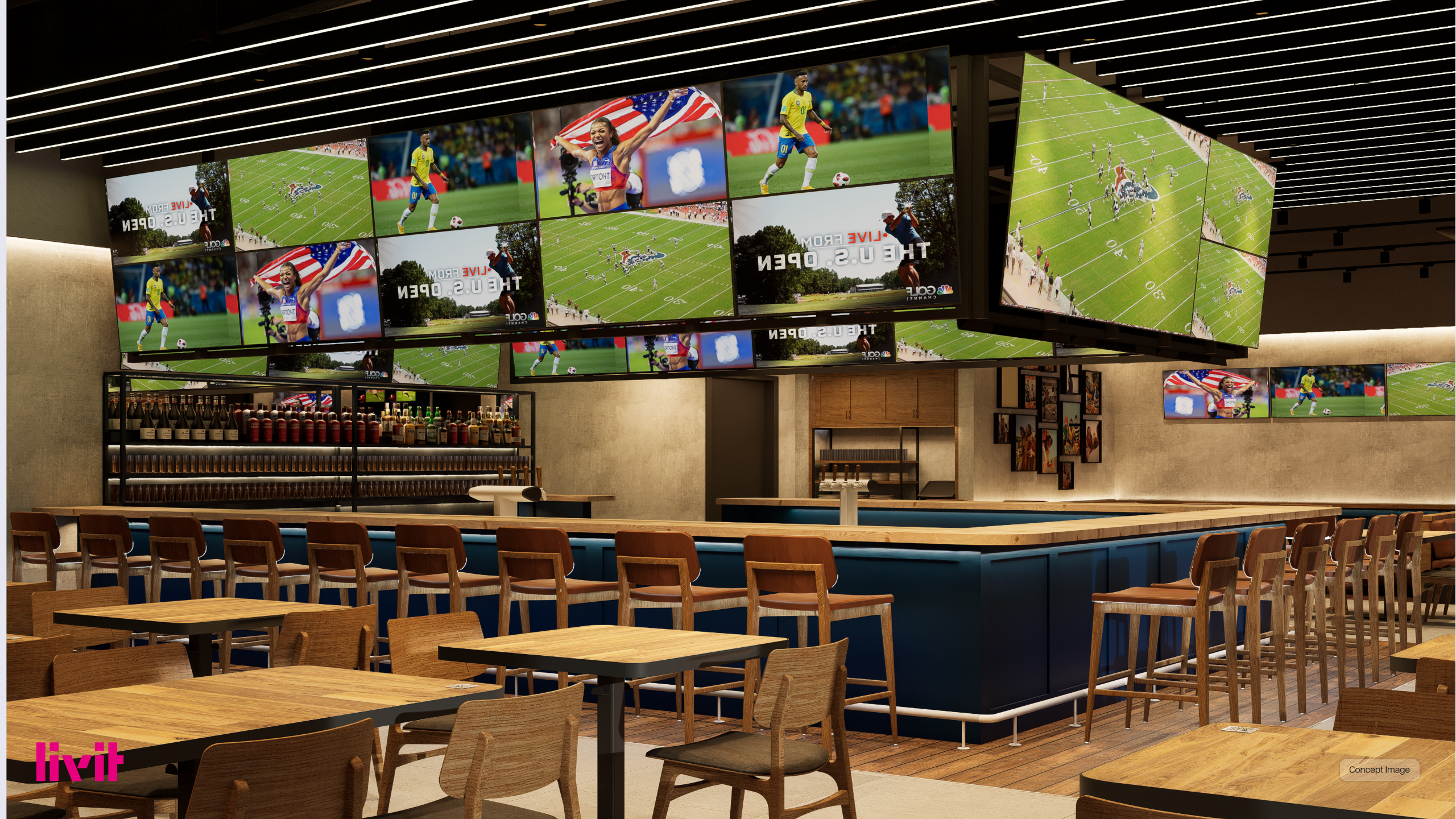
Walk into any Walk-On’s and the bar pulls attention first. Television placement and the bar itself serve as the epicenter of the room, a design principle the brand has followed from the beginning and one that carries directly into the new prototype. What changes is the scale. Legacy restaurants seated roughly 280 to 300 guests, while the prototype seats around 120 to 140, and Landry is confident the atmosphere survives the reduction. As he sees it, “you don’t need to fill 280 or 300 seats to create an energy that we had done in the past.”
Size cuts both ways. Landry points to casual dining brands that have closed or disappeared in recent years, and to the oversized buildings that have become harder to justify, largely because of cost. A room that feels cavernous on a quiet night works against the very experience a sports bar is selling. A tighter room, by contrast, fills up faster and feels alive sooner. The prototype also introduces optional lounge areas with leather couches, so guests can settle in to watch a game without sitting at a traditional dining table.

Food may earn the first visit, but Walk-On’s knows guests judge a sports bar on more than what arrives on the plate. Plenty of restaurants serve good food, and Landry sees the menu as one part of a larger equation. What turns a meal into a night out is the vibe in the room and the people creating it. That thinking shaped how the team approached the prototype, starting with the senses.
Energy, in Landry’s view, is something you experience across all five senses. Sightlines and TV displays matter, and so do music, the patio experience, street presence, signage, and even smell (the team has a meeting on the calendar devoted to identifying the right scents for Walk-On’s). A signature dish, however beloved, and engineering cannot carry that experience alone. You need the right people.
Where the Energy Starts
People complete the picture, and in Landry’s view, energy starts with the staff. The prototype does not need a crew of 100 to fill the room with life. A smaller team gives Walk-On’s room to be more selective, making sure every hire is bought in and trained properly. With fewer people on the floor, each team member carries more of the atmosphere, which makes getting the right people even more important.
That is where the Rumble earns its place. Each shift begins with the same burst of noise, pounding tables, and flickering lights, setting the tone for guests and reminding team members what they signed up for. A ritual born during a stretch of overwhelming days has become part of the brand’s identity, and Landry credits it with attracting great teammates. A tradition like that tells job seekers exactly what kind of place Walk-On’s is, which helps the brand draw people who want to be part of it.
That team-first energy flows directly to the guest. Walk-On’s built the prototype around the belief that guests want hospitality and a real sense of connection when they walk through the door, and a smaller room makes that connection easier to deliver. Landry is confident the new format keeps what matters most intact. He said “most importantly, we feel like we can get that connection with our guests and we can still be hospitable and still do all the things that we’ve known for today.” From menu, to the five senses to people the formula for success kept building within our conversation; we even spoke about the side door.
A Growing Business Through the Side Door
Sports bars are not typically the first stop for takeout or delivery, yet Walk-On’s has quietly built a substantial off-premise business. Across its restaurants, takeout and third-party delivery account for more than 20% of sales, with some locations approaching 30%. In some restaurants, off-premise orders have grown large enough to function as a separate business running out of the side door.
Landry credits the food, and the region that shaped it. Walk-On’s was built in South Louisiana, where the bar for a new restaurant is set high. “I tell people all the time, people don’t eat to live, they live to eat down here. So if you’re going to open up a restaurant, you better have good food.” That reputation means guests who are not in the mood for a game-day crowd still choose Walk-On’s for dinner, and a more convenient location only makes that choice easier.
With so much business moving through the side door, the prototype plans for it deliberately. Pickup cubbies and a potential order ticker help Uber and DoorDash drivers find what they need quickly, without crowding the entrance or interrupting guests inside. The goal is to run both businesses well at once, preserving the atmosphere for dine-in guests while keeping the off-premise channel efficient.
A Kit of Parts for Every Community
Walk-On’s has long been a family gathering spot, and the smaller box did not change that. Landry describes the scene the brand is known for: “we are known for that place when the T-ball game’s over and they bring the whole team and the kids can sit there and play Pop-A-Shot.” Franchise partners took part in the design sessions to make sure moments like that still had a home in the new format.
Rather than hand franchisees a single rigid blueprint, Walk-On’s developed a kit of parts. An owner opening in a bedroom community can dedicate space to Pop-A-Shot games, claw machines, and a small area for kids and groups. An owner in a market with stronger alcohol sales might choose the lounge, or a private viewing area built for hosting fantasy draft parties. Each version keeps the same core while fitting the neighborhood around it.

Behind the modular design sits a clear philosophy: standardize what defines the brand, and let the community shape the rest. Every prototype shares the same foundation, anchored by the scratch kitchen Walk-On’s refuses to compromise, the bar at the center of the room, and the energy the brand builds into every shift. Those elements travel from market to market unchanged, giving guests a consistent Walk-On’s experience wherever they find one.
The modular components are where each restaurant becomes its own. Franchise partners know their communities, whether that means a steady stream of youth sports teams or a crowd that gathers for fantasy drafts, and the prototype gives them room to act on that knowledge. Rather than asking every town to fit a single mold, Walk-On’s lets owners tailor the space to the way their neighbors actually gather, so the restaurant feels built for the community instead of dropped into it. The result is a model that stays consistent at its core while giving each location a local personality.
New Math for Franchise Partners
For all the attention on atmosphere, the prototype ultimately comes down to investment. Walk-On’s has historically built big boxes on large parcels, and franchise partners faced total investments of roughly $3 million to $6 million when they purchased the land. That entry point narrowed the field of potential owners, and the team began asking, “how do we fish in a much larger pond of franchise partners out there and really look at the economics of Walk-On’s?”
The prototype brings that number down significantly. “This next one we’re building, it looks like we’re going to be sub-$2 million on the entire investment, which we’re so excited about.” Walk-On’s already has a working model in Atlanta, where a 3,700-square-foot restaurant at The Battery, near the Braves’ stadium, opened about 15 months ago. Its investment came in close to half of the brand’s previous model, and the restaurant still delivers the full menu, bar, and atmosphere guests expect from Walk-On’s.
Atlanta also showed that the smaller footprint can stand on its own. Faster ticket times mean seats turn more quickly, so the team has not felt any need to add seats. Savings extend to staffing, too. Opening one of the larger restaurants once meant hiring 120 to 150 team members, and the prototype cuts that figure roughly in half, lowering opening costs along the way. “Every little thing matters.”
Speed follows the same pattern. Buying land, designing a building, and planning parking once stretched development timelines to 15 to 18 months, with site costs climbing throughout. Moving into existing end-cap spaces cuts that timeline roughly in half, to about six months from design. Walk-On’s expects to break ground on a nearby corporate unit within weeks, with a target opening just before the end of the year or in the first or second week of January.
Opening the Door to New Markets and New Owners
Lower costs reshape the map. Larger restaurants required certain population thresholds and traffic counts, which ruled out many smaller communities. Now, Landry says, “we feel like we can go in these secondary, and tertiary markets.” Furthermore it was expressed that even endcap units now fit the model. Towns that would not have been considered for a Walk-On’s three to five years ago are suddenly in play.


The same shift widens the pool of potential owners. Landry sees an old pain point dissolving, one captured in the question prospective franchisees used to ask themselves: “I want one, but I don’t know if I can.” Operators who once assumed ownership was out of reach are now reaching out, telling the development team, “I can be an owner now, right?” Landry understands the appeal. After all, “who doesn’t want to own a sports bar?”
Existing franchisees are responding as well. With the capital that once funded a single large restaurant, an owner can now consider two or three prototype units placed in different pockets of a city or region. Walk-On’s introduced the prototype to its system at its conference in Fort Lauderdale, and the development team has been fielding calls and emails ever since. One franchise group, which operates in Starkville and Southaven, Mississippi, and has roots in the smaller town of Grenada, is now eyeing markets for the new format.
Built to Adapt, Ready for 2027
Smaller does not mean Walk-On’s is trading its identity for a fast-casual model. Guests still receive full service, still order from a scratch kitchen, and still watch the game in a room built for energy. Landry frames the redesign as a matter of adapting before the market forces the issue. It took considerable work to step away from how things had always been done, but the team decided the risk of standing still was greater.
Momentum is building. Two or three prototype units are currently in design or under construction, and the development team has nine openings already scheduled for the first quarter of 2027. Landry attributes much of that pipeline to the new format, and he sees a milestone year ahead, noting that “2027 may be a record-breaking year for us as far as openings.”
For prospective franchise owners, the prototype lowers the investment, shortens the timeline, and opens communities that once fell outside the brand’s reach. For guests, the experience should feel familiar: Louisiana flavor from a scratch kitchen, a bar at the heart of the room, and a place for the whole T-ball team after the final out. At the start of every shift, in a room half the size, the tables will still pound and the lights will still flicker.
