


For decades, the familiar picture of brick-and-mortar franchise ownership was relatively straightforward: find a retail site, build or lease a standalone location, put the brand’s sign over the door, and begin attracting customers.
That picture is changing.
Increasingly, franchise brands are looking beyond traditional storefronts and exploring places where customers already have a reason to be. Airports, military installations, college campuses, hospitals, hotels, supermarkets, shopping centers, entertainment venues, travel plazas, and even large retailers can all become potential homes for what the franchise industry calls non-traditional locations.
For prospective franchisees, these formats can open an entirely different conversation about real estate and expansion. Instead of asking only, “Where should I build a restaurant?” an operator might ask, “Where are the customers already gathering?”
That distinction sits at the heart of non-traditional franchising.
What Is a Non-Traditional Franchise Location?
A non-traditional franchise location generally operates within, alongside, or as part of another destination rather than occupying the type of conventional standalone space most consumers associate with the brand. For a restaurant franchise, for example, a traditional location might be a freestanding building with dedicated parking and a drive-thru. A non-traditional version could operate inside an airport terminal, Walmart, hospital food court, university student center, or military exchange.
The concept extends well beyond restaurants. Service franchises, fitness concepts, retail brands, and other franchise systems can adapt their footprints for hotels, workplaces, shared commercial spaces, and other high-traffic venues.
What makes these locations especially interesting is that the franchise often becomes part of an existing customer ecosystem. The surrounding venue generates much of the traffic. A traveler needs to eat between flights. A student walks through the campus center each afternoon. A shopper is already inside a retail store. An employee wants lunch without leaving the workplace complex. Instead of building a destination from scratch, the franchise positions itself inside an established destination. That can be appealing, but it also creates a different operating environment.
Why Franchise Brands Are Looking Beyond the Street Corner
Real estate has always played an important role in franchising. The right corner, shopping center, or trade area can influence everything from traffic patterns to labor availability and visibility. Non-traditional development expands the pool of possibilities. A space that would never accommodate a conventional restaurant may support a smaller food-court format. A brand that normally depends on roadside traffic might find another audience inside a travel center. A franchise system seeking entry into a new market could gain exposure through a busy institutional setting.
These formats can also allow franchisors to match the footprint to the venue. Some concepts may offer limited menus, modified kitchens, kiosks, counters, or compact operating models depending on the location. That flexibility matters when conventional real estate is expensive, limited, or simply unavailable in a desired trade area.
Still, prospective franchisees should not assume “smaller” automatically means “simpler.” A non-traditional unit may include operating rules, venue agreements, restricted hours, security procedures, delivery limitations, and customer-access requirements that would not exist at a freestanding business. Understanding the venue is every bit as important as understanding the franchise.
Wienerschnitzel Brings the Strategy to a Military Base
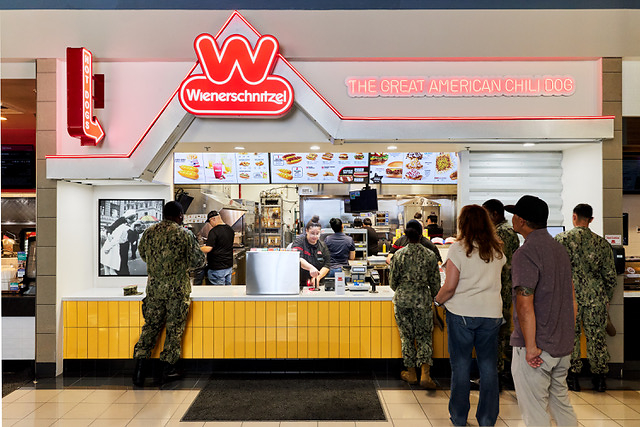
Wienerschnitzel recently demonstrated how an established franchise brand can leverage a non-traditional location to reach a distinct customer base.
The company announced on July 22nd, 2026, that it had opened its first restaurant on a U.S. military installation. The location opened in early July inside the Navy Exchange food court at Naval Base San Diego through the Navy Exchange Service Command, or NEXCOM. The restaurant serves Navy Exchange authorized patrons, including service members, civilian employees, and families.
For Wienerschnitzel, the opening follows other non-traditional development inside Walmart Supercenters. The company said it has opened restaurants in Walmart locations in Tempe, Arizona; Puyallup, Washington; Alamogordo, New Mexico; and Colorado Springs, Colorado, with additional Walmart restaurants planned.
“Opening our first restaurant on a military base is an exciting milestone for our brand and another example of how Wienerschnitzel can thrive beyond the traditional restaurant model,” said David Winter, Chief Development Officer for Wienerschnitzel. “Whether it’s a Walmart, travel center, or military installation, we’re finding new ways to meet consumers where they already are while creating additional growth opportunities for current and future franchise partners.”
The example illustrates an important element of non-traditional franchising: the brand follows the customer into places that already produce regular traffic.
Wienerschnitzel operates hundreds of franchised restaurants and offers several development formats, including freestanding drive-thrus, conversions, endcap, and in-line locations. Its move into retail and military settings adds another potential real estate path for franchise operators.
Where Can Non-Traditional Franchises Operate?
The category can cover a surprisingly broad range of locations.
Airports and transportation hubs are among the most visible examples. Thousands of passengers may move through a terminal each day, creating opportunities for food, beverage, retail, and service concepts. Train stations and major transit centers can offer similar possibilities.
Universities represent another distinct market. Students, faculty, and staff create a built-in population that can support restaurants, convenience concepts, and service businesses.
Hospitals and medical campuses can generate traffic from employees, patients, and visitors, while stadiums and entertainment venues can generate concentrated demand around games, concerts, and events.
Then there are retail partnerships. A franchise counter or restaurant positioned inside a supermarket, supercenter, or other major retailer can benefit from the shopping trips customers were already planning to make.
Military installations, such as Wienerschnitzel’s Naval Base San Diego location, represent another highly specialized environment. Access, contracting, and operating requirements differ from the conventional retail world, but the locations can provide access to defined communities of authorized patrons.
Travel plazas, casinos, resorts, hotels, office complexes and convention centers can also fall within the non-traditional category.
The common thread is not the type of building. It is the relationship between the franchise and a larger destination.
What Prospective Franchisees Should Examine
Non-traditional franchising introduces questions that deserve careful due diligence.
Start with access. Who is actually allowed to enter the property? A military installation, corporate campus or ticketed venue may have substantial traffic, but the customer pool can be restricted.
Next, examine traffic patterns rather than traffic totals. An airport might serve millions of travelers, but what matters to an individual franchisee is how many people pass the specific concourse or location, when they pass it, and whether they have time to purchase.
Operating hours also matter. Some venues dictate when businesses open and close. A university may have seasonal fluctuations. A stadium may experience dramatic peaks around events. An office complex may depend heavily on weekday traffic.
Franchisees should also understand the agreement structure. In some non-traditional environments, an operator may be dealing not only with the franchisor but also with landlords, concessionaires, government entities, retailers, or institutional partners. Questions about rent, revenue sharing, buildout responsibilities, required vendors, employee access, deliveries, security, signage, and renewal rights all deserve careful attention.
Finally, prospective owners should determine whether the franchise model itself has been designed for that environment. Kitchen capacity, staffing, inventory storage, menu breadth, and service speed can look very different in a 700-square-foot food-court space than in a freestanding restaurant.
Non-Traditional Does Not Mean One-Size-Fits-All
One of the most important lessons for prospective franchisees is that “non-traditional” describes a category, not a single business model. An airport unit is different from a university location. A Walmart restaurant is different from a military installation. A hospital food court has different demand patterns than a highway travel center.
The strength of the opportunity depends on how well the franchise concept fits the environment. A brand built around speed and portability may work naturally in a transportation hub. A concept with strong breakfast demand could find an audience in a hospital or office complex. A familiar quick-service restaurant may appeal to shoppers looking for a convenient meal during a retail visit.
Franchisees should evaluate the marriage between brand, customer, and venue, not simply the novelty of the location.
Another Path on the Franchise Real Estate Map
Non-traditional franchise development does not signal the end of the neighborhood storefront or freestanding restaurant. Traditional locations remain central to many franchise systems.
Instead, the strategy gives brands and franchisees another path. Wienerschnitzel’s move onto Naval Base San Diego offers a current example of what that path can look like. A restaurant brand historically associated with conventional quick-service locations is placing its menu in environments ranging from Walmart stores to Navy Exchanges.
For prospective franchisees, that broader shift is worth watching. The next franchise opportunity may still sit at a busy intersection with a recognizable sign and a parking lot out front. But it might also be beyond airport security, inside a university student center, alongside the grocery aisles, at a travel stop, or behind the gates of a military installation.
In today’s franchise real estate landscape, sometimes the opportunity is not about convincing customers to come to you. It is about finding the right way to go where they already are.
