


Ask what coding means at Code Ninjas, and the honest answer keeps changing. In 2017, it meant JavaScript, Lua, and a partnership with Roblox. Today it also means prompt engineering, machine learning, and a 120-hour AI Academy that didn’t exist eighteen months ago. What has never changed is the belief driving all of it: that “coding” was always shorthand for something bigger, the ability to take an overwhelming problem and break it into pieces small enough to solve.
Mike Rodrigues, VP of Franchise Development at Code Ninjas, has watched that belief hold steady while nearly everything around it changed. He joined the brand in October of 2018, when roughly 30 locations were open, and has since moved through pre-operational franchise support, corporate store operations, and franchise development, giving him a front-row seat to almost a decade of reinvention.
A Taekwondo Belt, Not a Programming Language, Started It All
Code Ninjas’ founder and former CEO was a software engineer by training, with a business already teaching adults to code before Code Ninjas existed. He also, somewhat unexpectedly, owned an Anytime Fitness location, and going through that brand’s franchise development process as a franchisee taught him how franchising worked; he even built some of the operational software Anytime Fitness used at the time.
The idea for Code Ninjas came from an ordinary afternoon. A father of two young boys, he was sitting in a taekwondo class one day when the belt system caught his attention, the steady climb from white to black built on discipline and earned progress, and he wondered whether that same structure could be applied to something he actually knew: software. Rather than build another program for kids who already thrived at traditional sports, he wanted to build one for the kids who would rather be behind a screen. “Code Ninjas was born as a place for kids to nerd out,” Rodrigues says. “We still use that expression as a badge of honor.”
Because the founder had already been through franchising as an operator, Code Ninjas was designed to franchise from the start rather than being retrofitted into one later. The brand launched in 2016 and began franchising the following year, opening its first pilot location in Pearland, Texas, a suburb of Houston. By the time Rodrigues arrived in October of 2018, roughly 70 territories had already been awarded, with about 30 open. Today, Code Ninjas has around 450 locations awarded and roughly 350 currently open, operating across four countries, including nearly 70 locations in Canada.
Coding Was Always Code for Something Else
Ask Rodrigues what the brand is actually building, and he doesn’t point to a coding language. “We’re not interested in pumping out a thousand Mark Zuckerbergs, although that would be cool,” he says. “But we want to teach kids how to navigate in a world that’s complex. We want to teach kids how to break down large problems into digestible pieces, and that is what coding can do if done the right way.” Coding, in other words, was never the finish line. It was the vehicle.
That distinction matters because it’s what lets the brand keep evolving without losing itself. Rodrigues describes the underlying goal as teaching “critical thinking,” an “algorithmic design to the process of thinking,” and the ability to “solve problems in a digestible manner.” Whether that shows up through JavaScript, robotics, or an AI prompt is almost beside the point. “We are in the process of creating the future problem solvers,” he says.


It also explains who the brand tends to reach. Code Ninjas draws plenty of kids who play sports, but it draws just as many who don’t, including a meaningful number of neurodiverse kids who find community there among peers who share their interests. Rodrigues, who grew up playing sports mostly because that was simply what was available to him, sees the parallel clearly. “It was an opportunity for me to make friends,” he says. “An opportunity for me to learn from somebody who had more knowledge. It was an opportunity for me to feel like I was part of something bigger than myself.” That’s the environment Code Ninjas recreates, just with a keyboard instead of a soccer ball.
Building a Curriculum Before the Vocabulary Existed
When Rodrigues joined in 2018, the brand ran on two things: a core Create program and a rotating slate of summer camps. Create took kids from white belt to black belt, ages seven to fourteen, built on a progression of JavaScript, then Lua (the language behind Roblox, which the brand partnered with directly at the time), then C#. Beginners started with block-based coding, dragging and dropping graphical pieces that functioned like ten lines of code, so a child who had never touched a keyboard could still build something that worked. In 2019, after noticing younger siblings kept wanting to do what their older siblings were doing, Code Ninjas launched a Junior program for ages five to seven, built entirely on block-based coding through a partnership with CodeSpark.
Camps became something more than a summer activity. They doubled as a low-risk way to test ideas before the brand fully committed to them. “Let’s not have everybody go out and buy all these cameras,” Rodrigues says, describing how the brand approached an early content-creation concept. “We can use webcams for now. We’ll build some content for a 5-day camp.” If a camp filled up and stayed full, that told the team something worth building on. If it didn’t, nothing had been lost.
That YouTuber-style camp is a good example of Code Ninjas getting ahead of a trend rather than reacting to one. Content creation wasn’t yet a mainstream career path when the brand first tested it, and artificial intelligence wasn’t yet a category anyone was building a curriculum around either. “AI wasn’t a thing back then,” Rodrigues says of the brand’s early years. The camp model let Code Ninjas try ideas early, watch what kids gravitated toward, and let genuine interest decide what got built out next.
When AI Wasn’t a Thing, Then Suddenly Was
As private equity investment arrived around 2021, bringing new capital to invest in additional programs, camp concepts that had proven themselves started graduating into standing programs. Sixteen-week clubs let kids go deeper into ideas that started as five-day camps, robotics moved from a camp-only offering into what is now a full Robotics Academy with 120 hours of content. The brand’s technology partnerships kept pace: an exclusive relationship with Microsoft’s MakeCode platform now houses Code Ninjas’ proprietary curriculum, Unity supports black belt game projects in C#, and Godot, another professional development environment, now anchors second and third-degree black belt work.


AI followed the same pattern, just on a much faster clock. Once the category became real, Code Ninjas built quickly: the AI Academy launched in October of 2025, delivering 120 hours of content on prompt design, prompt engineering, and the basics of how large language models work, not how to build an AI engine, but how to get useful results out of one. “The one thing that AI cannot do, it’s think,” Rodrigues says. “It can only generate based on the questions that you ask it. The better the question, the better the result.” Less than a year in, the brand has already cycled through and added more than a dozen new AI tools to the program. Between Junior, Create, Robotics, and AI, Code Ninjas now runs 36 camps, 12 clubs, and 9 workshops, including STEM badges for Girl Scouts, open houses, and school field trips.
Rebuilding the Dojo Around How Families Actually Show Up
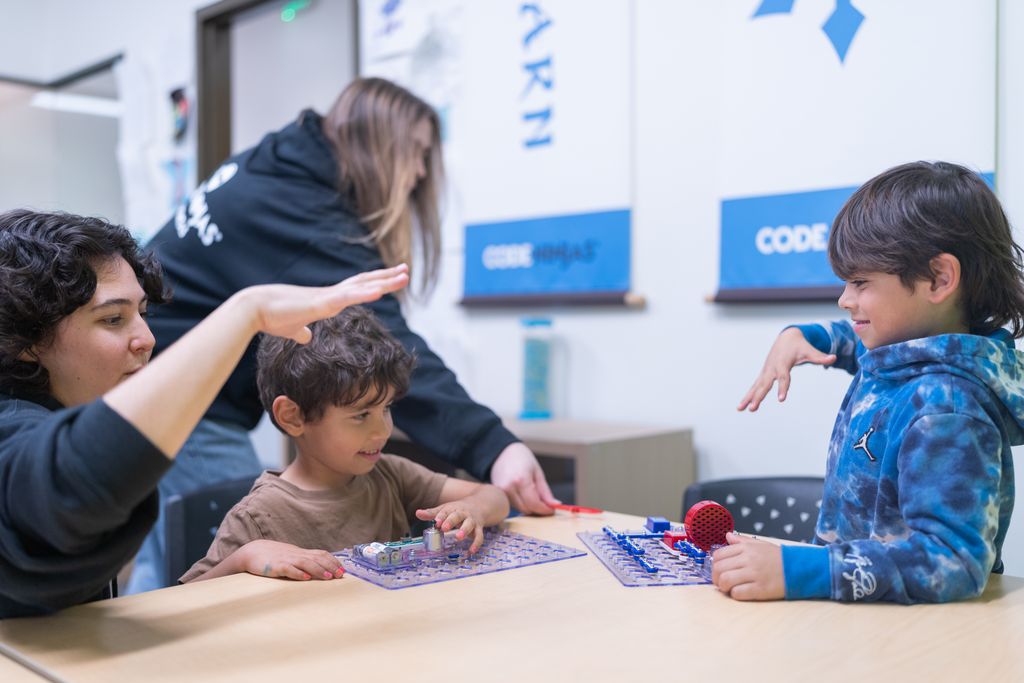
Curriculum wasn’t the only thing that evolved. Original Code Ninjas centers ran 1,800 to 2,000 square feet, built around a “fishbowl-style” dojo visible from three sides, where kids worked with staff on laptops, robotics kits, and snap circuits, while parents lingered over a coffee bar and free Wi-Fi during regular sessions, or dropped their kids off for evening parents’ night out events.
Over time, Rodrigues and his team noticed that most parents weren’t actually staying in the lobby, a pattern COVID-era occupancy limits only reinforced. “That hallway, those 2 restrooms, that is just non-revenue-producing opportunity,” Rodrigues says. Today’s model runs closer to 1,200 square feet, built almost entirely around the dojo, with the same seating capacity as the larger centers but far less build-out and operating cost. It also happens to match what’s available in most retail strip centers, where common shell spaces run 1,100 to 1,500 square feet, giving franchisees more real estate options than the larger end caps the brand once required.

The pandemic reshaped delivery too. When COVID forced learning online, the brand quickly discovered that remote instruction didn’t work as well for kids between five and fourteen, whose development depends on in-person social interaction in a way older teenagers’ doesn’t. Once restrictions lifted, Code Ninjas moved straight back to in-person instruction, but kept a version of what it learned: a hub-and-spoke model that lets a franchisee’s home center partner with nearby schools or community organizations, extending reach to kids who are close but not quite close enough for weekly visits, without crossing into another franchisee’s protected territory.
A System Built to Keep Catching What’s Next
None of this evolution happens by accident. Code Ninjas still operates a small group of corporately owned centers, which pay royalties and function exactly like franchise locations, giving the brand a live testing ground before anything reaches the wider system. A virtual reality coding program is currently partway through a 90-day pilot at one corporate location, tracking cost, labor, and franchisee return before the brand decides how far to take it.
Once a pilot shows promise, Code Ninjas brings in a small group of volunteer franchisees, often identified through its Franchise Advisory Council or its regional franchise business partners, and deliberately spreads that group across regions and countries. “We want to make sure that just because it works in California, that it also works in New York,” Rodrigues says. Only after that real-world feedback comes in does a full rollout begin, complete with training sessions, ordering guides, and playbooks built from what the pilot group learned.
Why Franchisees Get a Vote
That same instinct for listening shows up at NinjaCon, the brand’s annual conference, where the Franchise Advisory Council and Marketing Advisory Council weigh in on what comes next. “We put it up on screen, live voting, like Family Feud style,” Rodrigues says of how the brand narrows down new ideas each year. Rodrigues is candid about where the best ideas often originate. “We’re very much of the mindset of why reinvent the wheel when you can just put a little grease on it,” he says, describing how some of the system’s strongest practices started with a franchisee rather than corporate headquarters.
The Mindset Carries Forward
Underneath the AI tools and the tighter footprints, Code Ninjas still leans on the same basic idea about how kids learn that it started with. The brand treats Lifelong Kindergarten, a book by Mitch Resnick, as close to a foundational text: “Kids learn by play,” Rodrigues says. “But we all learn by play. Play just gets redefined as we get older.” Disguising problem-solving inside something kids already want to do, first through video games, now increasingly through robotics and AI, is what has let the curriculum keep changing shape without changing purpose.

That credibility isn’t just a feeling. Code Ninjas’ curriculum is certified by the International Society for Technology in Education, the organization that sets K-12 digital literacy and computer science standards globally. “We’re the first and only kids’ STEM franchise to ever have curriculum certified by the International Society for Technology in Education,” Rodrigues says.
Looking ahead, Rodrigues points to continued expansion of the AI Academy, potentially more advanced offerings for the 15-to-17 age range, early conversations around teaching entrepreneurship, and a possible pilot this year for a competitive, spelling-bee-style STEM event. None of it is set in stone, which is, in a sense, the point. Whatever shows up next in the world kids are growing into, robotics, AI, or something nobody’s named yet, Code Ninjas is building the version of itself that can meet it, one belt, one puzzle, and one dojo at a time.
