


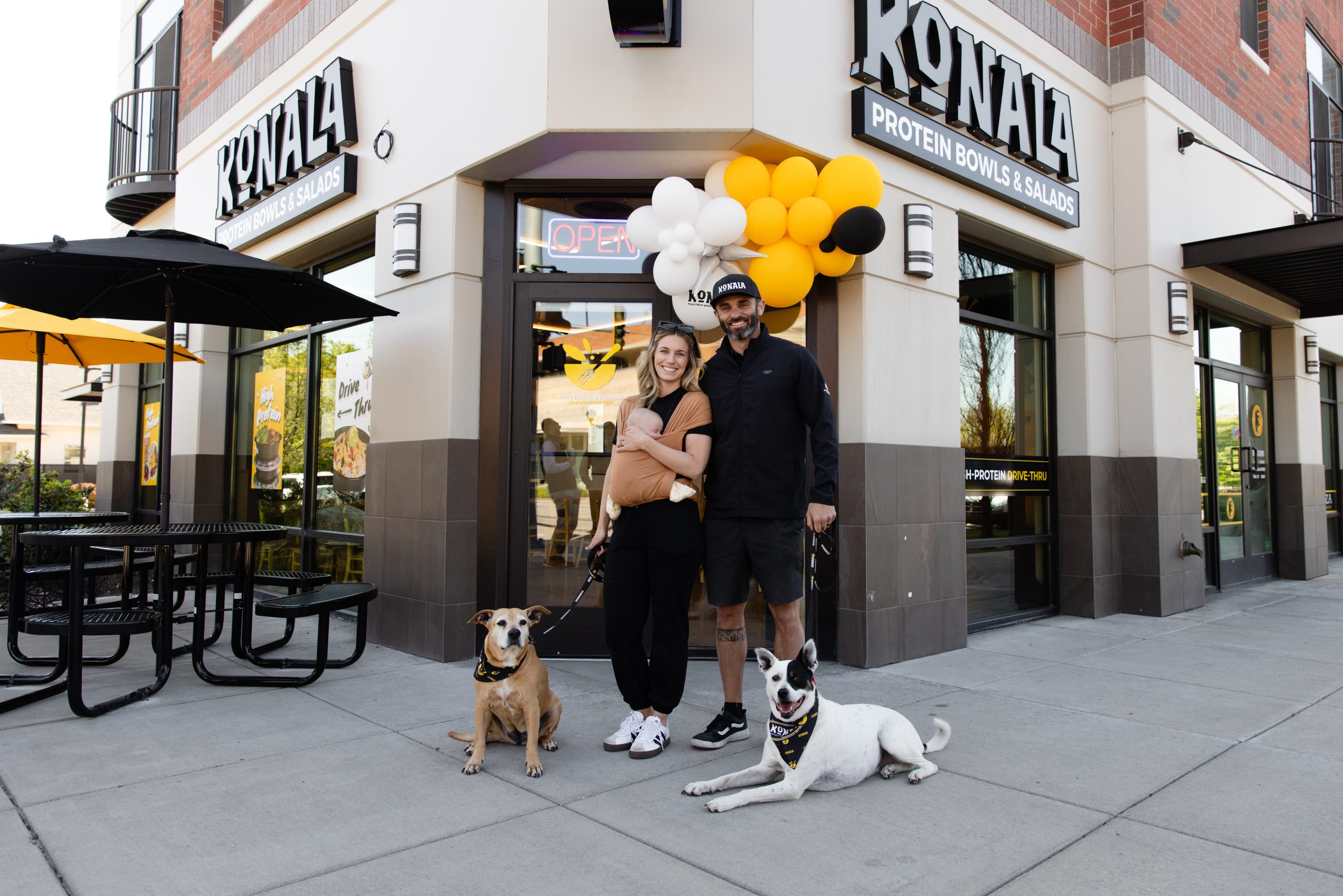
There are brands that follow the market, and then there are brands that seem to arrive exactly when the market is ready for them. Konala (pronounced Koe-Nah-Luh) sits firmly in the second category. Named after founders Trace and Jammie Miller’s two rescue dogs, Kona and Nala, the brand carries a warmth and intentionality that shows up in everything from the menu design to the drive-through experience. But beneath the approachable name is a concept built on a premise the fast-food industry has largely ignored: that eating well can be just as fast, affordable, and effortless as the options that have defined the drive-through lane for decades.
Miller’s path to this idea was anything but direct, winding through the Army, firefighter school, scuba diving in Hawaii, welding classes, a food truck, and a bar in Idaho. A single thread runs through all of it, though: a deep, personal understanding of what food can do for the human body, one that started before he could even read.
A Cure That Started at the Table
Miller’s relationship with food is not a lifestyle choice. It is, in the most literal sense, the reason he is alive. At age two, he began having seizures. By his third birthday, he had experienced his first grand mal seizure and was diagnosed with Lennox-Gastaut epilepsy, a severe and often debilitating condition. At the peak, he was having over 100 seizures a day. He wore a helmet everywhere he went. Doctors told his family he would not survive past his 13th birthday, and that he would never learn to read, write, or hold a conversation.
His mother, an athletic trainer and physical therapist with a health-forward mindset, found a doctor in Mexico who believed something different. Working through a combination of technology and nutritional modification, meaningful change became possible, but it was not easy. The treatment required weighing everything down to the gram. Every element of his diet was precise, specific to him, and carefully constructed. Keto nearly killed him. Red foods were eliminated entirely. What worked was balance: carefully calibrated, whole-food-based meals that gave his body exactly what it needed.
By age seven, Miller was completely cured, with no ongoing symptoms. He describes himself as, to the family’s knowledge at the time, the first person ever cured of Lennox-Gastaut epilepsy without continued medication. He grew up eating differently than most children, and it shaped everything about how he understood food, health, and what a balanced meal actually looks like.
“I saw the power of nutrition early on,” Miller said. “It just seemed like second nature to me to eat well. When I got to college, the military, everything after, I realized that people overcomplicate what eating healthy looks like.”
That realization became the mission. For the next 14 to 15 years, Miller taught meal prep and coached people in the military, in college, and in workplaces on how to eat better. The education was always the same: keep it simple, keep it balanced, and make it repeatable.
From Food Truck to First Principles
Miller never planned to be in the restaurant business. After the Army, firefighter and EMT training, scuba instruction in Hawaii, and a stint in welding school, he and his wife Jammie started a food truck together. The goal was simple: use it to fund the neighborhood bar Jammie had always dreamed of owning, a community gathering spot with the feel of a place where everyone knows your name. Within five months, an opportunity came to buy an existing bar concept, flip it into their own, and park the food truck out front. Jammie ran the bar. Trace ran the food truck. He learned, as he puts it, through trial by fire.
It worked. The bar won Best Bar in Idaho three years in a row and Best Burger in Idaho three years in a row. But Miller was already thinking past the win. His grandfather, an early mentor who owned an architecture firm and did real estate development, had taught him that the best businesses solve a problem. Looking at the bar and food truck model, Miller could not find a problem worth solving beyond their local community. The format was too hard to scale, too dependent on individual talent, and too complex operationally for a five-hour service window.
So he went back to the drawing board, starting not with a product but with a mission. “The problem is inaccessibility to healthy food,” he said. “Konala’s mission is to make eating healthy as delicious and convenient as possible.” Those two words, delicious and convenient, became the design criteria for everything that followed.
Simple Scales. Fancy Fails.
Konala’s menu is built the way Miller taught meal prep for fifteen years: a reliable protein, a carbohydrate base, and fresh vegetables and fruits, assembled in a way that keeps macros front and center and boredom at a distance. Bowls average 46 grams of protein and 654 calories, with all proteins cooked on-site in smart ovens that operate as air fryers without any added oils or butter. Chicken thigh, chicken breast, and steak are the protein anchors. White rice, brown rice, and greens are the bases. Fresh vegetables and fruits complete the bowl. The sauces are where flavor lives, and they are where Miller focused his energy to make the menu both nutritious and genuinely craveable.

“How you don’t get bored of meal prep is you keep a few certain proteins as your go-to and switch out the sauces,” he explained. That same philosophy drives the Konala menu: a tight, consistent base with rotating limited-time sauce offerings that keep regulars returning without complicating the kitchen.
Every item on the menu is also gluten-free, a decision that came naturally given how the menu was constructed. With whole proteins, rice, and fresh produce as the foundation, gluten-free compliance required almost no compromise. It also made good business sense: roughly a quarter of Americans eat a gluten-free diet, and Konala’s clean ingredient approach made it an easy box to check. The one exception required deliberate effort. Teriyaki, a natural fit for the bowl format, is typically not gluten-free, so Miller worked with a co-packer to develop a proprietary version sweetened with honey, free of seed oils, and lower in sodium than traditional alternatives. Macro and calorie counts are displayed on the menu for every item, making it easy for customers to log directly into MyFitnessPal or any calorie-tracking app. Eating well, the brand insists, should not require a nutrition degree.
The Drive-Through as a Health Delivery System
Convenience is not just a value-add for Konala. It is structural. Miller knew that no matter how nutritious the food, a healthy concept without speed and accessibility would lose to the golden arches every time. “No one plans a meal out at McDonald’s,” he said. “You’re tired, hungry, and you forgot to go grocery shopping. You see the golden arches on your way home, so you pull in. If we can be that for other people, with great locations, a convenient drive-through, and speed, then we can meet that impulse buy and just be a healthier impulse buy for them.”

Every Konala location includes a drive-through, and the majority of sales flow through it, even at locations with full interior seating. The design draws inspiration from operators like Dutch Bros, 7 Brew, Chick-fil-A, and In-N-Out, all of which use face-to-face ordering rather than a static speaker box. At Konala, customers order from a person holding a tablet. Kiosks exist as an option, but the emphasis on personal interaction is deliberate. Automating the kitchen is a goal; automating the customer relationship is not.
Approximately 60 percent of Konala’s customer base consists of families and parents who appreciate the convenience of a drive-through that does not require unloading children from the car. Another 30 percent are gym-goers and fitness enthusiasts who stop in after workouts or pick up multiple meals to refrigerate for the week. Within those communities, a simple reputation has taken hold: for many regulars, Konala has become what Miller calls a gym junkie’s dream.
Campus-Ready: Where the Next Generation Eats
If Konala’s drive-through model was built for the family on the go, the brand’s college campus strategy is a natural extension of the same logic applied to a generation already moving in the right direction. Miller sees visible cultural shifts among younger consumers: they drink less alcohol, think more critically about nutrition, and prioritize their health in ways prior generations often did not discover until much later in life.
“I really think that being near people who prioritize a healthy lifestyle just makes sense,” Miller said. “If we can help educate on what eating healthy means and just have that option in other communities, people will be a lot healthier moving forward.”
Konala recently opened adjacent to Gonzaga University’s campus, situated across the street from the basketball stadium in a building that includes student housing, a gym, and another food concept. A second location is opening near BYU’s campus in Provo, Utah. Students eat later, move faster between obligations, and seek options that align with their values around fitness and wellness. The brand is testing adaptations for this market, including later operating hours and lower-price snack items like air-fried tenders that deliver high protein at a more frequent, accessible price point. The existing snack bowls, which maintain the same protein profile as full bowls but simplify the build to meat, sauce, and rice, are already positioned for the snack and study-break occasion. As campus data comes in, the offer will be refined around how students actually live.
Built to Replicate: The Franchise Model
From the beginning, Konala was designed not just to work in one market but to travel. Miller’s mantra, “simple scales, fancy fails,” is as much an operational philosophy as a branding one. The kitchen equipment is minimal. The menu is tight. The supply chain runs on national accounts for everything from modular building components to food sourcing, giving franchisees consistent access to ingredients and equipment anywhere in North America. There are no freezers at Konala. All proteins are cooked fresh on-site, and the fresh ingredient supply is available nationally through distribution partners, with co-packed sauces handled through the same system.


Konala currently has four open locations, with additional units opening in the near term and 49 more in development. The brand began franchising in 2024 and is selling only to multi-unit experienced operators. Miller is deliberate about the profile of franchisees he brings in, emphasizing consistency and long-term brand integrity over speed of unit growth. Franchise sales are sold out in Idaho and nearly sold out in Utah, with operators already in place in Southern California, Pennsylvania, New Jersey, and other markets currently in the pipeline. Corporate cluster expansion into Nevada is also underway.
New franchisees go through a four-week training program at Konala’s headquarters in Coeur d’Alene, Idaho, followed by an on-site support team deployment at opening. The brand built its operations manual before selling a single franchise and tapped the same construction playbook partner used by other major players in the compact drive-through space for its own site development process. Real estate selection, construction, and buildout are supported through a six-step opening process with dedicated playbooks at each stage. The physical format offers real flexibility: a modular under-800-square-foot drive-through and walk-up unit can be installed from foundation to opening day in as few as five weeks, or the brand can build out tenant spaces, end caps, freestanding locations, and full conversions. Several locations have been built on former Carl’s Jr. and Arby’s buildings, which already carry proven drive-through infrastructure and visibility.
The Confidence of Simplicity
Discovery days at Konala have shown a consistent pattern: even experienced multi-unit operators with no restaurant background, once they walk through the kitchen setup, feel confident they can run it. “The simplicity of our kitchen ops gives them the confidence to realize that they can do this,” Miller noted. Multi-location management experience and people skills matter more, in his view, than prior restaurant ownership. The franchise model was built to support that kind of operator, with playbooks and support infrastructure already in place for each stage of the opening process.
Marketing, Community, and the First Friday Effect
For a young brand entering new markets without the recognition of legacy fast-food chains, building a customer base requires both digital presence and genuine community engagement. Konala provides franchisees with in-house marketing support and a full suite of centralized materials and initiatives designed to drive traffic and brand awareness. One of the most effective tools is a monthly promotion called First Friday: on the first Friday of every month, the brand runs a buy-one-get-one on a featured bowl. The program creates a predictable monthly event that drives repeat visits, generates social sharing, and keeps the brand visible even between purchases.

Beyond promotions, Konala’s marketing strategy centers on education: teaching customers what eating healthy actually means, what balanced macros look like, and how the Konala bowl fits a realistic daily nutrition routine. Miller sees this educational mission as a long-term community health investment, especially near campuses and fitness communities where the message already resonates with the people most likely to become regulars.
A Market That’s Finally Catching Up
Miller is candid about the broader forces working in Konala’s favor. Consumer education around nutrition is accelerating. Social media, better access to research, and a cultural move away from trend-based dieting are pushing people toward a more fundamental understanding of what food does to the body. High-protein eating, which Miller sees not as a trend but as standard nutritional science finally getting its due, is now mainstream. Fiber, he predicts, will be the next focus as more people connect whole-food sourcing to long-term health outcomes.
He also cites a striking data point about the gap Konala is designed to address: studies suggest the average American consumes over 3,600 calories per day while engaging in less than 20 minutes of physical activity. The overconsumption of unhealthy calories, combined with under-investment in movement, creates exactly the problem a fast, clean, macro-transparent drive-through concept is positioned to solve, not with a lecture, but with a better option at the moment the hunger hits.

“I think health is wealth,” Miller said. “If you prioritize your health, it ends up being cheaper in the long run. People are starting to realize that treating the cause is the future, rather than just treating the symptom.”
Younger generations are already living this shift. They are spending more on food quality, drinking less, and demonstrating that health-conscious purchasing is mainstream consumer behavior, not a niche preference. Konala is positioned squarely in the path of that behavior, with a format that removes the last barrier most people cite for not eating healthy: it takes too long and is not convenient enough.
Kona and Nala probably do not know that their names are on the side of a growing fast food concept. But the origin of that name says something true about what Konala is: it is personal, it is built around what matters, and it was named by someone who has never taken good health for granted.
