

Walk-On’s Sports Bistreaux closed the holiday season with a nationwide giveback that was deliberately simple and intensely hands-on; cooks cooked; teammates delivered; neighbors received. Across the system, restaurants prepared and distributed more than 7,500 meals through local non-profits chosen by each location. Partners ranged from the Delaware Township Food Pantry to Cobb County Fire & Emergency Services to Brennon’s Blessings; the connective tissue was local choice and real food made by the teams who serve those neighborhoods year-round.
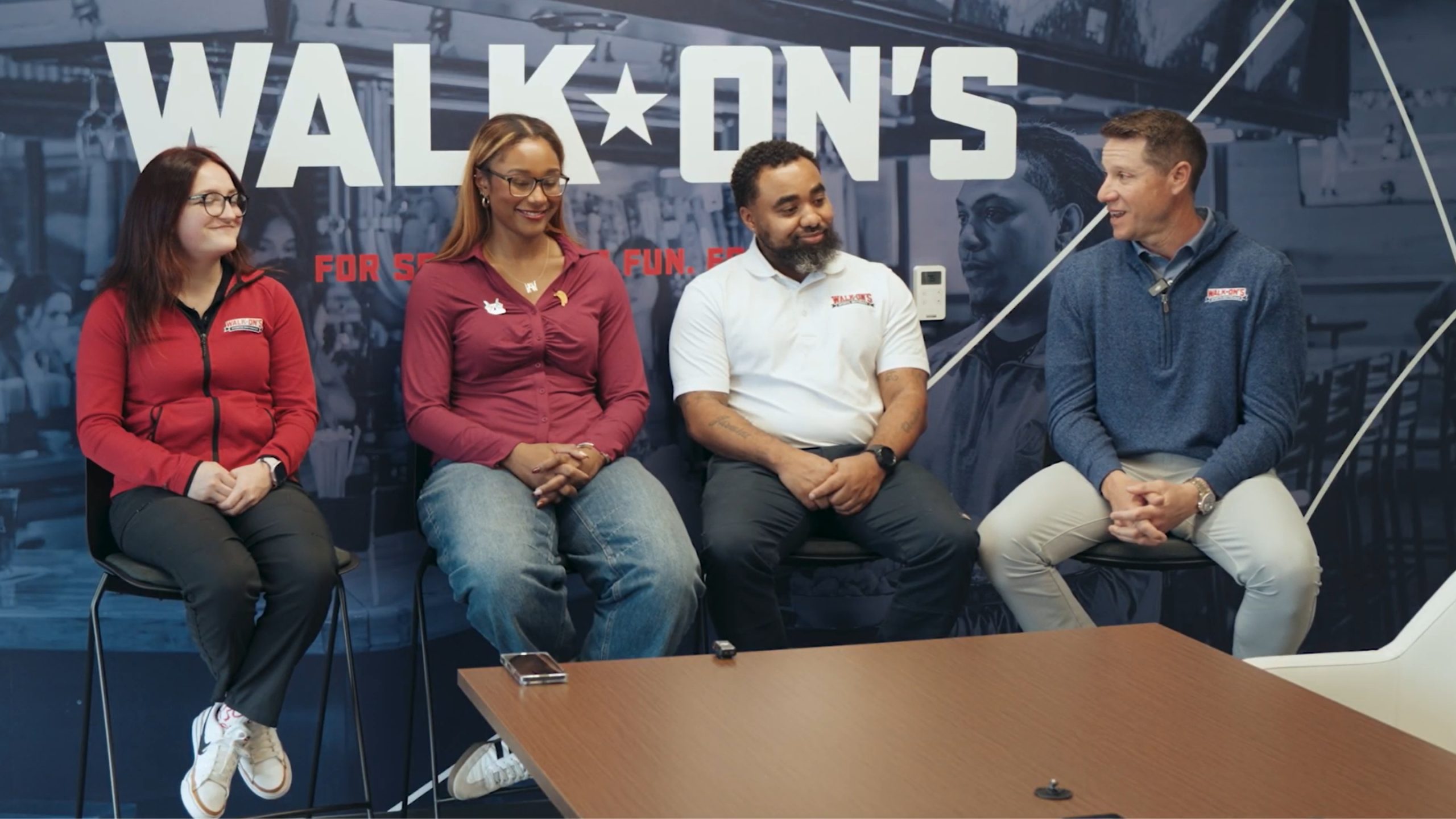
The effort, supported in partnership with Coca-Cola, doubled as a window into the brand’s culture. It showed how an “underdog” identity becomes a habit, how recognition travels from the dish pit to the GM chair, and how small rituals like a pre-shift chant turn work into a team sport. I sat down with Founder & CEO Brandon Landry, and in our conversation, I kept noting that it returned to the same idea: impact scales when it is ingrained in how you operate, not bolted on as a seasonal campaign.
“Being part of the Walk-On’s family means taking care of the communities that take care of us,” said Brandon Landry. “Partnering with Coca-Cola to give back this holiday season is something we embrace and are honored to have the chance to make a real difference.”
How Brandon Landry’s Walk-On Years Forged the Underdog Mindset
Brandon Landry’s philosophy was built on the LSU hardwood. As a former walk-on with the men’s basketball team in the late 1990s and early 2000s, he learned to compete without entitlement and to outwork expectations. That early experience became the brand’s operating system. “Everything that we’ve done for the last 23 years has really been built on that underdog mindset,” he said. “Our vision is just to be more than a restaurant and inspire that lifestyle that embraces that underdog mindset.”
For Landry, the underdog is not a slogan; it is a daily standard that shows up in how people are developed and how teams show pride. His view on differentiation makes the point. “Anyone who has a restaurant, hopefully has good food, right? So we could talk about our food all day, and you’re not differentiating yourself from anyone,” he said. “With us and our story… we live it each and every day. It’s more than just writing on the wall.” The mindset is the message; show up like a walk-on, lift the person next to you, and let the culture be obvious in how the team performs.
Inside the 7,500-Meal Drive
The holiday initiative turned Walk-On’s underdog mindset into action at scale. Each restaurant selected local non-profits that mattered to its team and community; the company supplied outreach tools, timelines, and a simple ops checklist; then the kitchens executed. In practice, teams cooked full Walk-On’s meals in-house, staged hot trays, and coordinated logistics with partner organizations. Some restaurants delivered directly to the non-profits; others scheduled on-site pickups. The cadence fit the crunch weeks before the holidays, when need spikes across food pantries, community groups, and first-responder partners.
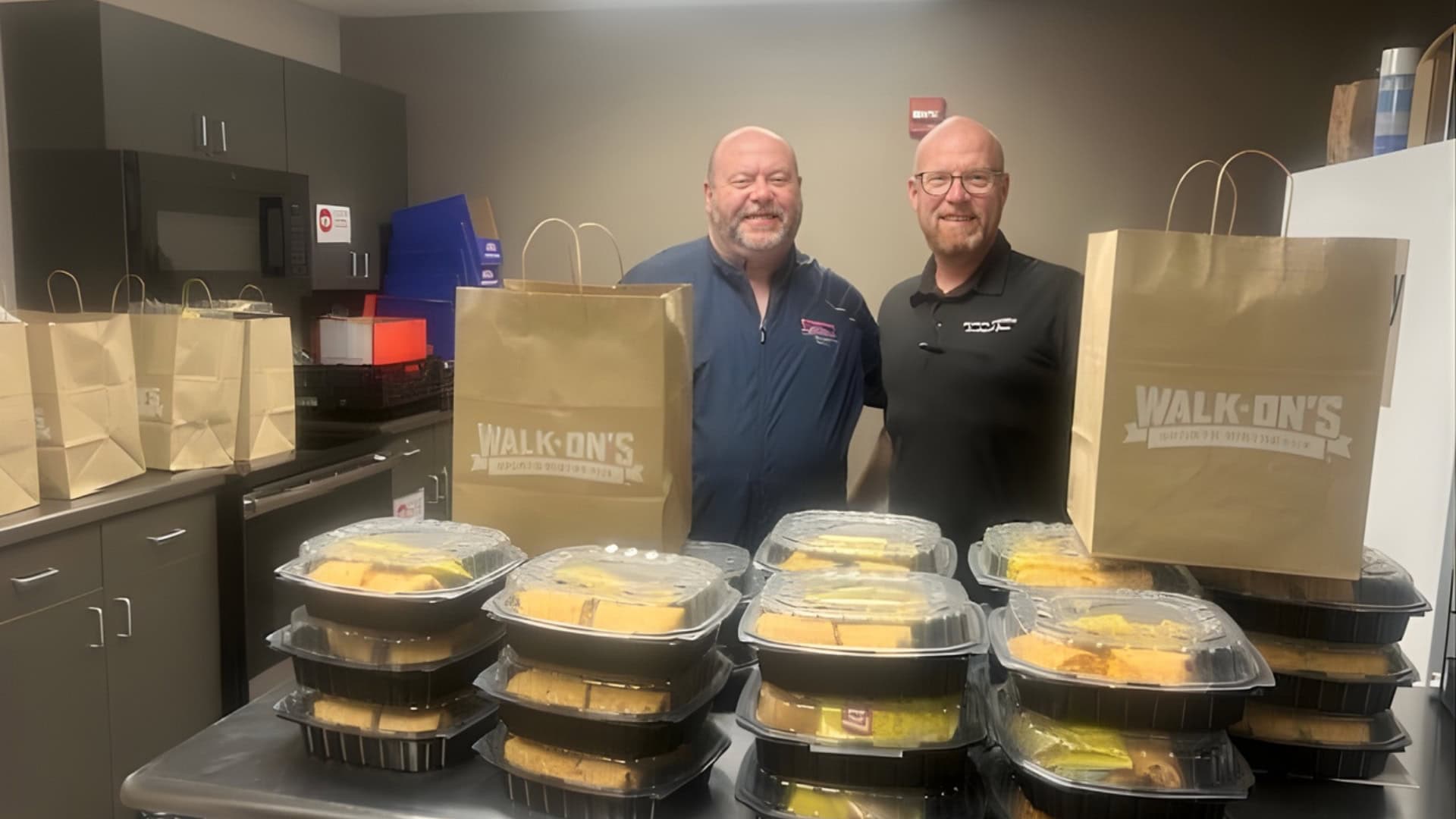
What made this distinct was the intensity inside the four walls; pre-shift huddles ran with purpose, line cooks worked in sync, and managers coordinated handoffs with the non-profits’ distribution teams. The focus was clear; produce quality food at volume and move it efficiently to partners with established distribution lists and protocols. It was not “here’s a check” or “here are some fries”; it was hot, branded Walk-On’s cuisine prepared in-restaurant and transferred to trusted organizations equipped to reach families and individuals across their networks.
Momentum built quickly as franchise partners compared notes and shared outcomes. Several locations reported streamlined handoffs with food pantries and community groups; others worked with first-responder partners to route meals into existing outreach programs. The throughline held; local selection plus hands-on execution created a play operators wanted to repeat and scale. As Brandon Landry put it, franchisees “were talking about it and all the other ones were like, how do we do the next one?”
Coca-Cola’s Role; A Partnership That Fits The Playbook
Coca-Cola helped underwrite the meals and a parallel moment of recognition for standout team members in Walk-On’s internal development path. Landry described Coca-Cola as partner that leans toward service, in working with them they asked Walk-Ons how can we help. Over two decades in, the fit is cultural. As he framed it, vendor relationships become force multipliers when they amplify what the brand already believes: community first, team recognition, and consistency. That approach kept local control with each restaurant while giving the system a shared initiative to rally around.
Food You Can Taste in the Story
Walk-On’s is candid; “anyone that has a restaurant hopefully has good food.” The point is not to diminish the menu; it is to center the differentiator; how the team shows up and the impact that has across the restaurant and community.
The giveback worked because the food is craveable; it travels; it connects. The kitchens prepared signature Walk-On’s items; the same flavors guests order for a big game or a wind-down; now boxed for families who needed a lift. This is the brand’s strongest play; let the food do what food does best; comfort and bring people together; then let the team amplify it with service and presence.
Process, not a poster: how impact scales inside the system
Ask Landry how community engagement scales, and he answers quite simply. “We host Walk-On University once a month… new managers [and] new franchisees. That is where it all begins.” At the University, their team showcases this is who we are and what we do. Heart is not eventually added; it’s ingrained in team members and partners from day one.
This can be seen in the days of training where the brand supplies local restaurant marketing frameworks, templates, guidance, and participation. “What we do for marketing is community engagement,” he adds; the team is there to help franchise partners execute gives, school nights, youth league support, or local theater fundraisers.
The emphasis is on repetition over fireworks. Anything scales, Landry argues, when you put process behind it and hold to cadence. It fails when it is treated like a periodic stunt. That is why ownership of the “four walls” is a mantra; “If we own our four walls in our local community, we know we’re going to be successful.” The tactics are familiar; the discipline is the differentiator. Local teams select causes; central teams equip; partners like Coca-Cola add lift; leadership celebrates wins and people.
Recognition That Travels: Surprise $3,000 Awards
Inside the initiative, Walk-On’s staged a recognition moment in Atlanta that doubled as a signal to the entire system about what the brand values. Three team members (Chris, Trinity, and Hannah) in the internal Blue Chop program were invited to Coca-Cola’s world headquarters. There, Landry and the partners surprised them with $3,000 each as a personal gift. It was unfiltered recognition for commitment and growth.
He described the feeling plainly; “It was kind of like Undercover Boss. It was one of those moments… that was a special deal for me.” The parallel is personal; Landry appeared on the show in 2020; he remembers the emotion of changing someone’s day in an instant. He went on to discuss recognition, appreciation, and family. In that moment, you could transcend time and picture being on a basketball court, at the dining room table, or in a restaurant kitchen, and what you felt was the same love and camaraderie. The awards were public appreciation for private effort; an echo to the rest of the teams that the brand sees the climb and rewards it.
The Blue Chip path itself is a core mechanism for turning jobs into careers. In Landry’s words, it lays out the ladder “from just showing up to get a job and an hourly position to possibly being a salaried manager… a shift lead… a general manager.” He cites a “young lady that started off… as a teenager… as a hostess” who now runs a $6 million restaurant, and another who moved from hostess to new-restaurant opening leader, helping open more than 20 locations. The point is durable; the program takes big talk about opportunity and converts it into clear steps and real promotions.
What It Means To The People: Chris, Trinity, Hannah
The stories behind the awards bring the idea to life. One honoree, Chris, expressed gratitude while also defining what Walk-Ons means. “They have my name on the front door; it’s a big achievement for me; I never thought that was possible.” He goes on to say “This is real family, that’s what Walk-Ons stands for.” Chris, began as a prep cook; today, he is an executive kitchen manager trusted to lead a high-volume restaurant, set standards, and mentor line cooks who are where he once was.
Chris explained that sometimes people don’t understand. When he gets up early, he puts in extra work without being asked, and sometimes others wonder why. For Chris, it boiled down to one thing: “because they take care of me; they help me take care of other people. That’s the biggest part of my job that I love—helping other people.”
Trinity’s path underscores how training and trust become confidence; the shift where a coach hands you the clipboard because you earned it. She shared, “My home restaurant got me to where I am, but the blue-chip program really put it into perspective that I can be more than I ever thought I could be.” In many ways, the gift recognizes someone along the journey. But one thing I uncovered within the conversations is that Walk-Ons teaches people to believe in themselves. That is priceless because it transforms people in a way that cannot be comprehended until you look back 5, 10, or 20 years.
Energy
Hannah’s presence is felt in a different way; energy. In a meeting chant captured on video, she leads a loud, joyful call-and-response that turns the room’s hum into a locker-room spark. There is laughter; there is rhythm; there is a team finding a collective heartbeat. We are not quoting that video; we are describing what it shows: a ritual that compresses culture into thirty seconds. Take a look!
That chant matters because it is the opposite of performative culture. It is not a poster; it is a practice. It sets the tone; guests feel it; managers notice the tempo shift; cooks pick up the cadence on expo; servers carry the beat to the floor. Those few moments put language and movement to the idea Landry keeps returning to:
“It’s more than burgers and beer… it’s being a part of community… making sure that we’re rewarding those underdog stories.”
When a first-time hire stands in that circle, they do not have to guess what the brand is about; they can hear it.
Start With Why; The Philosophy Behind The Plays
When the conversation shifts to advice for other franchise leaders, Landry goes straight to first principles. Culture beats campaign. “It just can’t be a campaign,” he said. “Invest in it; make it part of your core values and guiding principles… If we know why we’re doing it, then the what and how come easy.” That line maps perfectly to what Walk-On’s did over the holidays. The “what” was meals, deliveries, awards; the “how” was local choice plus central scaffolding; the “why” was the underdog mindset; the belief that a restaurant can be a daily source of belonging for the team inside and the neighborhood outside.
Practical Takeaway for Franchise Operators
For franchisees and franchisors reading this with an eye to replication, here is what we gleaned from Walk-On’s:
- Make impact the plan, not a seasonal slogan. Tie community work to training, scorecards, and leadership calendars. Make it a monthly practice, not an occasional retreat.
- Let local teams choose; give them tools. The restaurant knows its neighborhood; the brand provides outreach templates, logistics guidance, and a clear approval path.
- Design recognition that signals the destination. The Six Man ladder shows exactly how to climb; the $3,000 awards delivered as a surprise at Coca-Cola HQ showed that the climb is valued.
- Codify energy in a ritual. A pre-shift chant seems small, but it binds people together. It is teachable on day one and repeatable on day one hundred. It is culture made audible.
- Tell the food story through service. Good food is table stakes; hot meals handed to a local partner make the story tangible. That is what guests remember; that is what teams feel proud of.
The Heart Of It; Names On The Front, Names On The Back
Landry carries a line that sums up the Walk-On’s philosophy: “Take care of the name on the front and the name on the back will be taken care of.” You can hear that idea in the way managers talk about their crews, in the pride when a prep cook becomes an executive kitchen manager, in the noise of a chant before the first ticket drops. It is an approach that travels from the line to the lobby; care for the team and the team will care for the guest; care for the community and the community will care back.
By the end of the holiday push, the tangible result was more than 7,500 meals; the intangible result was momentum. Franchise partners who participated asked how to join the next giveback; others asked for the playbook; teams who delivered meals told stories back at shift change; the chant got louder; the game plan felt real. The brand will take that energy into March; from holiday plates to hoop-season round-ups; from a season of giving to a season of play. The thread is consistent; Walk-On’s treats community as offense, not a special teams play.
