


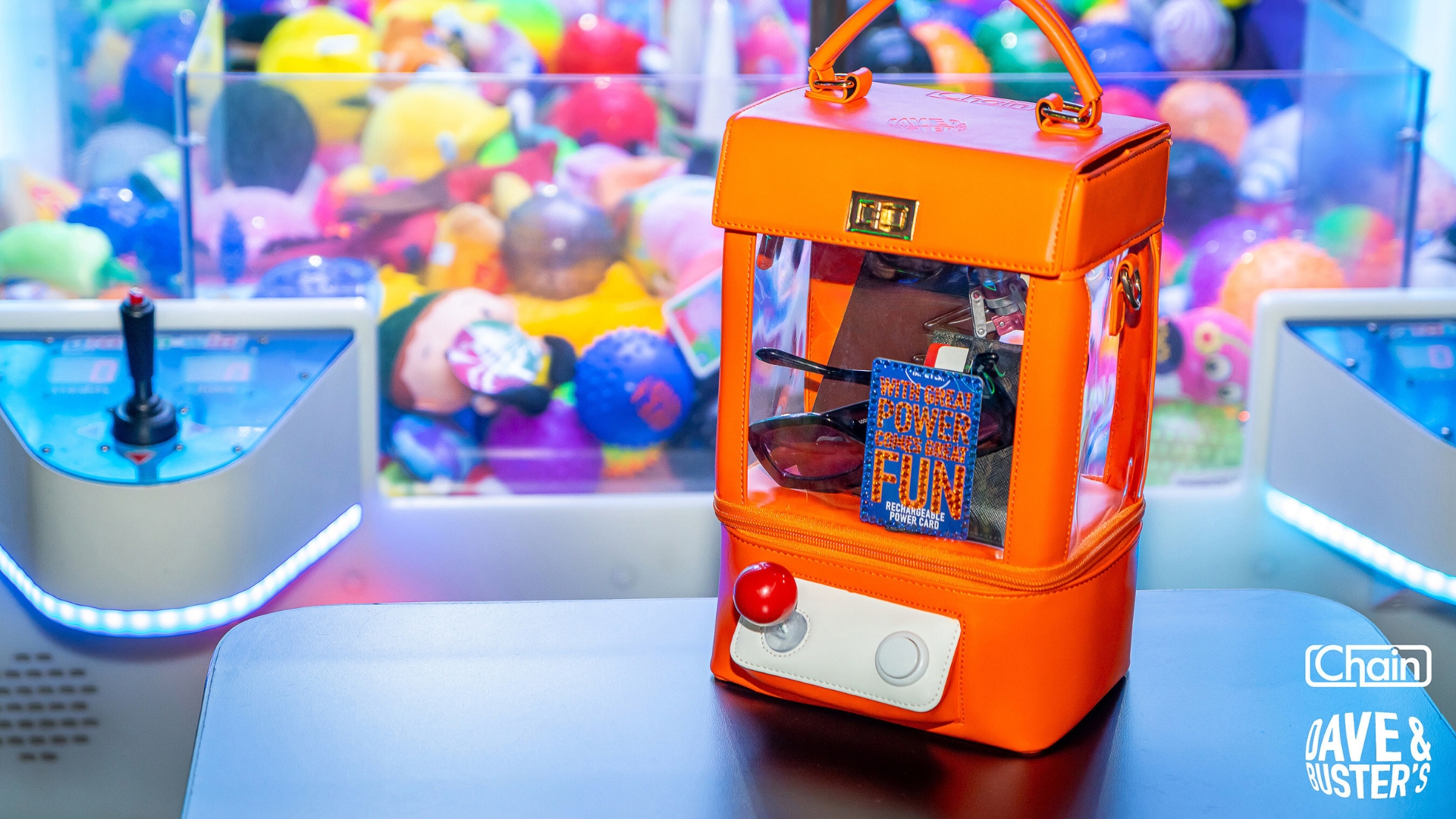
Dave & Buster’s revealed a limited-edition Claw Purse made with Chain; a bright orange, clear-paneled accessory with a sculptural claw charm that feels like a mini arcade you can carry. The claw purse arrives as the brand’s Human Crane expands to more than 112 locations with additional stores rolling out through the season. It sells for 80 dollars on shop.daveandbusters.com and eatatchain.com, and for us at Franchise Brief it doubles as a case study in ideation that opens doors for teams across a franchise system.
“At Dave & Buster’s, we’re always looking for new ways to bring our guests into the experience,” said Melissa Powers, Senior Director of Marketing at Dave & Buster’s. “The Claw Purse is a fun, unexpected extension of one of our most loved games and a celebration of the Human Crane’s expansion nationwide. Partnering with Chain to bring this idea to life helped us tap into a fresh, cultural perspective and the result is a fashion accessory that reminds people great entertainment can show up anywhere, even your purse.”
Chain’s collaborator frames the spirit with a grin. “Demna did the Chips bag and Spade made ketchup packets into a clutch, so it only seemed right to us to work with Dave & Buster’s to create a Claw Machine bag,” said Nicholas Kraft, Chief Creative Officer of Chain. “Hopefully finding your keys in The Claw Purse is easier than winning a prize in an actual claw machine.”
Ideation, Not Magic
Great franchise ideas rarely appear as finished products; they start with a “what if” voiced out loud in a room that allows curiosity. What if a beloved arcade icon left the game floor and walked into fashion, what if guests could become the claw instead of watching it, what if holiday gifting met gameplay in a single wink. Those questions sound playful, yet they aim directly at brand truth. Dave & Buster’s invites people to eat, drink, play, and watch; the Claw Purse and the Human Crane invite people to carry that play into new contexts.
Ideation works when a team treats imagination like a muscle. Not every prompt becomes a product, and that is the point. You float ten ideas so you can spot the one that fits your promise and your guests. In a franchise system, the stakes feel higher since consistency protects the business. Paradoxically, that is why leaders need to defend ideation time; people propose bolder, sharper ideas when they know the room will listen rather than judge.
The Claw Purse reads as a natural extension because the “what if” sat close to the brand’s iconography. A clear silhouette, a recognizable claw, a color that pops in photos; the idea tells its own story. Ideation that hugs a core symbol travels faster across a network because everyone can retell it in one breath. The lesson; keep your brainstorming tied to assets only your brand owns. The more specific the origin, the more universal the appeal.
Where “What If” Meets The Work
A productive ideation culture starts with permission. Leaders set the tone by asking questions that invite possibility rather than demanding proof on slide one. What if our signature experience could live in a different format, what if a seasonal moment became a small collectible, what if we gave guests a role in the spectacle rather than a seat at the edge. The questions do not require budgets yet; they require nerve and imagination.
From there, craft matters. Dave & Buster’s did not flood the world with random merch; the team shaped a single object that photographs well, sits neatly near an installation, and fits the holiday window. That is the bridge from ideation to impact. You take the best “what if,” you shape it with care, and you launch it where guests already have a reason to smile and share. Franchise teams appreciate that kind of clarity because it respects the floor; a good idea is one the store can execute without friction.

Partnerships can amplify this. Chain operates at the intersection of pop-culture and pop-cuisine; the studio brings a cultural lens that keeps the object from feeling like a souvenir. Inviting an outside collaborator does not replace internal ideation; it validates it. Your team frames the question and the guardrails, your partner brings fresh references and humor, and together you land something that stands out in a scroll and in a store.
A Field Guide To Ideation That Invites Your Team In
Rather than a checklist, think of this as a rhythm you can feel throughout a season. Begin with a prompt that everyone can answer; a single sentence that links your brand promise to a playful possibility. Share the prompt with marketing, operations, culinary, merchandising, and the field. Ask for short, vivid pitches; two lines, one image, a reason to care now. You want ideas that explain themselves without a meeting.
Create small rooms where ideas can breathe. Ten minutes at the top of weekly huddles, a dedicated channel where franchise business coaches post guest “overheards,” a monthly open mic with three quick pitches and no slides. Your goal is not volume; your goal is habit. When the habit locks in, team members who notice a pattern at 7 p.m. on a Friday feel confident enough to throw an idea into the mix on Monday.
Choose one idea before you perfect it. Make a modest prototype; a mockup, a sample, a short video. Show it to people who will use it and people who will sell it. Listen for the line they repeat back to you; if the explanation takes too long, the idea needs a simpler frame. The Claw Purse tells itself at a glance; that is a high bar worth chasing.
Put the moment where it belongs. The Human Crane creates natural theater; a display nearby makes the purse feel inevitable. In restaurants, bars, family entertainment centers, gyms, and auto services, every brand has a stage. It might be a pickup counter, a scoreboard, a fitting room, a photogenic wall. Ideation shines when you place the idea in the path of joy rather than the path of transaction.
Finally, promise to share the learning. People contribute ideas when they believe the organization will close the loop. A friendly postmortem in plain language, a quick note that credits a franchisee who sparked the thought, a snapshot of the metrics that matter; these gestures prove that “what if” has a home in your system.
Why This Matters Now
Franchise brands compete for attention and affection as much as for transactions. Ideation, done with intent, creates stories your guests want to pass along. It gives local teams reasons to smile, reasons to start conversations, reasons to feel proud of small wins. A limited drop that sells briskly tells you something about demand; a moment that photographs well tells you something about how your brand shows up in culture. Both pieces inform the next idea.
The Dave & Buster’s example also underlines timing. A purse with a wink arrives as gifting heats up; a full-body game expands as families look for shared experiences during the holidays. Ideation rises when you give it a season to lean on. Pick moments in your calendar that promise emotion; playoffs, graduations, back-to-school, local festivals. Then ask the “what if” that fits. What if our hero item cheered for the home team, what if our service puzzle; say a 20-minute wait with restless kids, turns into a family challenge. For example: give a one-page “Arcade Eye-Spy” or menu-math card; if the family completes it before their name is called, they earn something table-side. What if our loyalty perk felt like an invitation rather than a coupon. These questions point your teams toward moments where guests already want to say yes.
What To Put In Your Franchise Backpack From This Article
The Claw Purse will sell out or it will not; either outcome teaches. The larger win is cultural. A team asked a good “what if,” shaped it into a simple object, linked it to a living experience, and timed it to a season that loves conversation pieces. That is a map any franchise system can read. Protect rooms where ideas can be voiced, tie prompts to your core symbols, make prototypes small and visible, stage them where joy already happens, and share what you learn without drama.
Ideation does not require a special department; it requires leadership that invites possibilities and rewards the courage to speak them. When people see their “what if” turn into a real thing, they notice that the organization values curiosity. The next time someone hears a guest ask a clever question, they will write it down rather than let it pass. That is how a culture shifts; one idea voiced, one idea tried, one idea evolved into impact.
PS. The Claw Purse is sold out on Dave & Buster’s Website
