Haven Is Reimagining What Childcare Can Be for the Modern Family
By placing fully licensed childcare, shared and private workspace, and fitness under one roof, Haven is building a new category in familycare and inviting franchise partners to grow with it.
There is a version of the working parent’s morning that everyone knows too well. The alarm goes off before the sun does. Breakfast is whatever survives the scramble. The drop-off runs long, the commute does not cooperate, and somewhere between the car and the desk, the gym visit that was supposed to happen simply did not. By 9:00 AM, the day already feels behind. Britt Riley lived that version. She just refused to accept it as permanent.
Riley is the founder and CEO of Haven, a membership-based concept that brings fully licensed childcare, professional workspaces, and fitness together in a single facility. The idea did not come from a boardroom or a business school case study. It came from the particular exhaustion of being a new mother with a marketing career, a 1-year-old, a newborn, and a growing sense that something in the system was fundamentally broken.
“I just couldn’t figure out how to parent and work and feel good about all of it at the same time,” Riley said. That tension, familiar to millions of dual-income households, became the seed of Haven.
The Problem Nobody Was Solving
Riley came up with the concept in 2017, well before the pandemic reshaped the conversation around remote work. At the time, she was traveling frequently for her marketing work and paying close attention to where the workforce was heading. Dual-income households were becoming the norm, workplace flexibility was on the rise, and yet childcare, workspace, and personal wellness still operated as three entirely separate trips, three separate billing cycles, and three separate layers of daily pressure. The math simply did not add up for working parents, and nobody was solving it.
She started asking the people around her whether this was just her problem. It was not. So she lost, in her words, “a ton of sleep” until she figured out how to get the first Haven club open.
That first location opened in August of 2019, seven months before COVID-19 closed it down, temporarily. What happened next was something Riley describes as both painful and clarifying. During those three and a half months when the world was home with its children, the problem she had been trying to solve played out on every Zoom call and newsfeed in the country. The CEO with a toddler climbing his chair. The newscaster whose child wandered on screen mid-broadcast. Suddenly, the case for Haven did not need to be argued.
“Before, you could talk to people about the concept and they would say, yeah, that’s nice, or that’s cute,” Riley recalled. “And then it became, of course. Obviously. That just makes sense.”
Redefining What Familycare Actually Means
Haven does not call itself a daycare. Riley is deliberate about that. The concept she built operates under a different philosophy, one she calls family care, and the distinction matters.
Traditional childcare, she argues, has consistently left out one of the most important pieces of the puzzle: the parent. If a parent is burned out, distracted, or pulled in too many directions, the ripple effect reaches the child. Family care means tending to the whole unit.
“We’re trying to bring as many of the stress relievers, as many of the elements of things which can help them feel good, under one roof,” Riley said. “And so it really is family care. We’re caring for everyone.”
The difference shows up in ways that are easy to feel but hard to measure in a traditional childcare setting. When a parent knows their child is safe and thriving a floor below, the mental load that normally hums in the background of every meeting, every call, and every attempt to focus simply quiets. There is no commute anxiety about pickup time, no nagging guilt about being unreachable, and no mental split between being present at a desk and being present as a parent. The proximity changes something. Focus sharpens. Energy that would otherwise leak into worry stays available for the work in front of them.
A fitness area inside a Haven center features cardio equipment and a bright, open layout designed to support parents during the workday. Image Courtesy of Haven
Fitness became part of the model for a reason Riley describes with complete candor. After having two daughters, she found it nearly impossible to carve out time to take care of herself. Getting to a studio required a drive, a schedule, and a window of time that rarely opened. At Haven, a Peloton bike is a half-floor away. Between a meeting and school pickup, that half-hour becomes possible. And the endorphins that follow have a way of making the second half of the day look even better than the first.
A Day at Haven: What Members Actually Experience
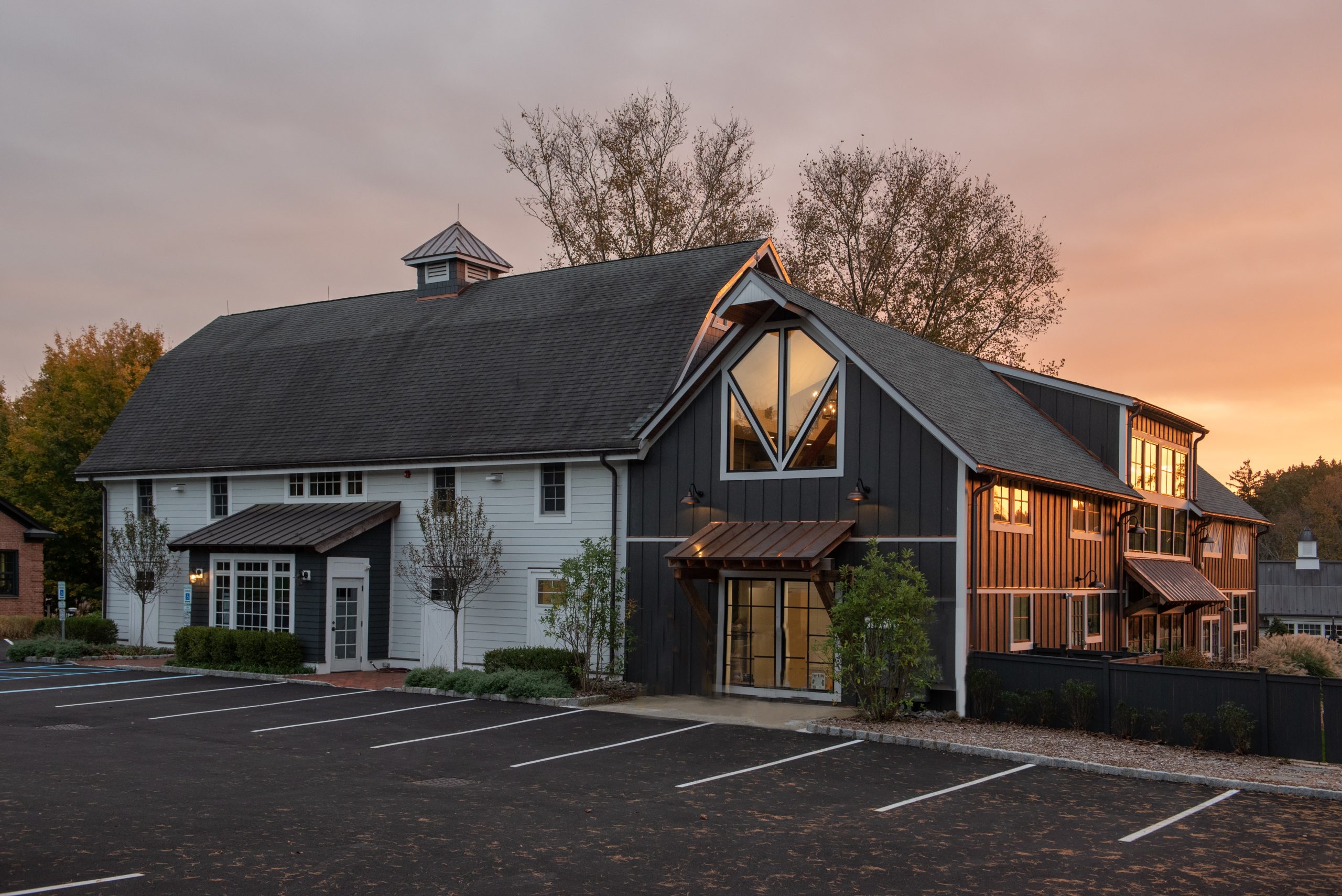
Clubs generally operate from around 7:30 or 8:00 AM until 5:30 or 6:00 PM, with workspace and fitness accessible beyond those hours for members who need it. The layout is intentional: in a two-floor building, all licensed childcare lives on the first floor. Parents drop off at the front door, then choose how they want to spend their time upstairs.
Image Courtesy of Haven
Some parents grab a coffee, find a quiet desk, and work through their full day. Others drop in for a few hours, take a meeting, squeeze in a workout, then pick up their child at the end of the afternoon. Massage therapists and aestheticians rotate through the clubs on scheduled days, so when the timing lines up, a member can wrap up a work session and walk into a massage before the school day ends. Haven has calculated that members who use the full model avoid roughly 29 full days of driving per year compared to managing each of these services separately.
A workspace inside a Haven center features desks, lounge seating, and private booths designed to support parents during the workday. Image Courtesy of Haven
Riley experienced it firsthand for a couple of years, bringing her own daughters to the club while she worked. She calls it “the most amazing thing ever,” and that perspective still shapes how Haven designs the member experience today.
The Village, Made Real
Parents have long been told it takes a village. Haven builds the infrastructure for that village to actually exist. The community that forms inside its clubs is not incidental; it is woven into the model.
Beyond the daily rhythms of work and childcare, Haven works hard to create moments that bring its community together. Some are planned and recurring, others grow organically from what members themselves want to build. A few examples Riley shared give a sense of the range:
Monthly date nights give parents a proper evening out while children stay at the club for a craft and dinner, with mid-evening photo updates so parents can actually relax knowing their kids are having just as good a time.
Book clubs and family days create regular touchpoints throughout the year.
Seasonal outings, including visits to an alpaca farm, take the community beyond the building entirely.
Clothing swaps draw enough contributions to fill an entire room, where parents trade outgrown gear, strollers, and supplies for the next stage of parenting, with the feel of shopping among friends rather than strangers.
“The Village is this mythical wonderland that every parent is told exists,” Riley said. “It does exist at Haven.”
Shaping Young Minds: The Haven Method
Riley came to childcare from marketing, not early childhood education. That outsider perspective turned out to be an asset. Rather than defaulting to a single philosophy, she pulled from multiple early education frameworks to build something designed for the specific outcomes Haven cares about.
The resulting curriculum is called the Haven Method. At its core, it is less about academic preparation and more about building the kind of child who is ready for anything. Character development, independence, and a strong sense of self sit at the center of the approach. The goal is to create an environment where children feel so safe and secure that they are not constantly looking for reassurance, freeing their minds to be genuinely curious, to explore, to ask questions, and to develop the foundational qualities they will carry into every stage of life that follows.
An educator leads a small group learning activity with young children at a Haven center, highlighting the brand’s focus on early childhood development. Image Courtesy of Haven
Research from the Harvard Center on the Developing Child confirms that the early years represent the most active and consequential window for brain architecture, with more than one million new neural connections forming every second in the first few years of life. Haven’s approach is built around that window deliberately, treating the quality of a child’s early environment not as a nice-to-have but as the foundation everything else is built upon.
Building the curriculum followed the same logic Riley applies to every part of the business: find people who are born to do the work, give them what they need, and then get out of their way. Haven now operates with a dedicated curriculum team, a learning management system, and ongoing professional development programs that support educators at every level. Teacher experience is treated as an input to quality, not an afterthought.
A New Franchise Vertical Built Around a New Consumer Need
Haven currently operates three corporate locations. Franchising represents the next chapter, and Riley has approached the supporting infrastructure with the same intentionality she brought to the original concept.
Locations are not one-size-fits-all. Haven works with prospective franchisees to identify what a market calls for, thinking in terms of small, medium, and large club formats rather than stamping out identical footprints. Architectural support and site selection are already part of the resources available to franchisees, alongside operational, marketing, and curriculum support. Riley describes this investment as deliberate over-building for the early stage, ensuring franchisees have real support from day one rather than figuring it out alone.
“We’re going to grow into our boots as opposed to chasing anything,” she said.
The membership model is built around simplicity. Members pay one all-inclusive fee covering childcare, workspace, and fitness together, not three separate charges for three separate services. Pricing sits at a premium compared to a standard childcare center and below a full-time nanny, placing Haven at the top of the market while delivering a meaningfully broader experience. A typical club employs two to three administrators and anywhere from roughly 15 staff members at a smaller location to around 30 at a larger one, with approximately two to three educators per classroom.
What Haven represents in the franchise landscape is something genuinely new: a concept that blends categories consumers already know, licensed childcare, professional workspaces, and fitness, into a single integrated membership. The category is early, and that is precisely the opportunity for operators willing to grow with it as consumer sentiment shifts from curious to committed.
The Heartbeat Behind the Business: Who Haven Is Looking For
Riley does not describe the ideal Haven franchisee in terms of industry background or resume credentials. She talks about something harder to quantify and easier to spot in a first conversation.
Haven is looking for what she calls impact investors, people who genuinely want to watch their work make someone else’s life better. From the moment a new member steps into a Haven, the relief is visible. The franchisee who thrives here is the one who finds that moment motivating, not incidental.
“We’re looking for people who are the heartbeat of the club and community,” Riley said.
The model works best when ownership covers two complementary functions: a community builder and a business manager. Sometimes that is one person who brings both. More often it is a couple or a business partnership where strengths balance each other. Riley points to her own relationship with her business partner Morgan as a working example of that dynamic. Candidates do not need a background in childcare; each Haven location hires an experienced childcare director to lead on the operational side. What owners need to supply is curiosity, openness, and a genuine instinct to show up for people.
Images Courtesy of Haven
Riley describes the opportunity as a chance to “live a whole life.” The work is meaningful, the community builds around the product, and the daily experience of running a Haven is oriented around helping families rather than managing transactions.
Where the Trends Are Heading, and Why Haven Is Positioned for Them
Riley watches the landscape with a founder’s attentiveness. The forces that shaped Haven’s origin in 2017, the rise of remote and flexible work, the migration of families from urban centers to suburbs, and a growing premium on quality of life, have only accelerated. She sees the next five years as a period of continued structural change in how people work, parent, and prioritize their own wellness.
Artificial intelligence, in her view, will not replace the kind of human-centered work Haven does. It will, however, free up time. Fewer people will sit in offices doing procedural tasks. More people will have flexibility, and with that flexibility will come renewed attention to how they structure their days, where they raise their families, and what kind of environment supports both.
Further Interest In the Category
Corporate interest is beginning to emerge as a parallel growth story. While the model is currently driven by individual memberships, employers and developers are starting to recognize Haven as a benefit worth investing in. Some employers are working with staff to support Haven memberships as a remote work productivity solution. Residential developers building communities near major employers have approached Haven about bundling memberships with new home purchases, treating family care access as a community amenity in the same tier as a fitness center or green space.
“It’s becoming one of those things where everybody really understands how important it is to take someone’s whole experience into account,” Riley said, “whether it’s hiring an employee or trying to attract people to a certain area.”
Haven’s current expansion focus is the suburbs of major and emerging gateway cities, communities where residents carry hybrid schedules, value neighborhood feel, and are relocating away from dense urban environments to raise their families. For the right franchise partner in the right market, it is a business with daily meaning, a community that builds itself around the product, and a category with significant open space ahead of it.
To working parents caught in survival mode, Riley’s advice is straightforward. You do not have to keep doing it the old way. You do not have to fit parenting into whatever shape other people expect of it. The village is not a myth. It just needed like-minded people bold enough to build it together.
Tim Katsch is the publisher of Franchise Brief and an Embedded Talent Partner and advisor to franchisors, helping teams land priority hires and strengthen talent acquisition through practical systems and real market insight. He is a former franchisor EVP who led operations, real estate, construction, and marketing across a national system.