


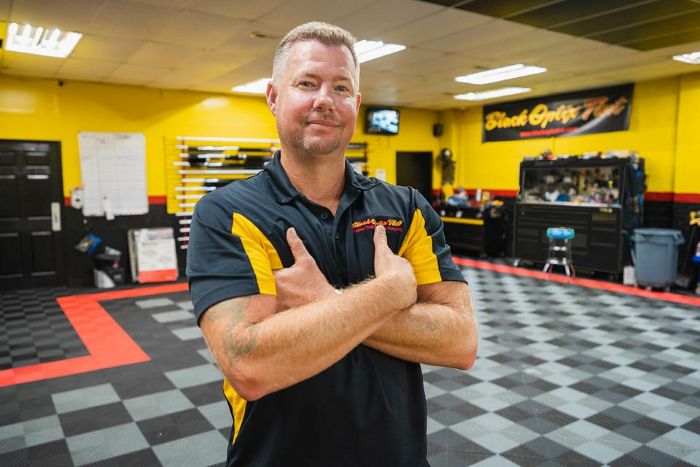
Randal Moore had no master plan when he followed his mother from Richmond, Virginia down to Myrtle Beach, South Carolina. He was a young man trying to find his footing, and for a while, nothing quite fit. School felt slow. Local jobs did not pay enough to make the math work. Then his younger brother mentioned a window tint shop whose owner wanted to sell, and something clicked. Moore was 21, had very little, and said yes anyway. That decision became the origin story of Black Optix Tint, a rapidly growing franchise brand in the automotive and specialty services space.
Moore did not set out to build a franchise empire. He set out to pay his bills. The arc of that modest ambition to leading a brand with 34 open units, 60 sold territories, and international expansion on the horizon is, to put it plainly, the kind of story that makes you want to quit your desk job and start tinting windows.
Wrong Side of the Map, Right Side of the Hustle
Moore grew up navigating the kind of environment that tends to close doors before they open. He was heading down the wrong path, by his own admission, before following his mother to Myrtle Beach, South Carolina. Moore thought about joining the military. Then he enrolled in a business program. Neither stuck. Formal education felt slow and disconnected from the urgency he already felt to make something of himself.
The break came through family. His younger brother, working as an installer at a local window tint shop, mentioned that the owner wanted to sell. Moore went to check it out, not sure what he would find, but something about the place caught his attention immediately.
“The place was really busy, and I was impressed,” Moore recalled. He structured a small asset sale, acquired the phone number, kept some of the equipment, and brought on a couple of employees. He opened under a new name, never went back to school, and never looked back.
Moore was 21. The plan was simple: make enough to support himself. What happened next was not part of the plan.
The Recession That Built a Business
When the 2008 financial crisis hit, most small businesses braced for the worst. Moore’s shop in Myrtle Beach did the opposite. That year, the location generated $650,000 in gross sales. He was managing the shop, doing some of the tinting himself, working every angle. Somewhere in the middle of all that volume, a thought landed with the kind of clarity that changes everything.
“I was like, man, you could put one of these in every city,” Moore said.
That thought did not stay theoretical for long. Moore noticed there was only one other tint franchise operating in the country at the time. He visited a few of their locations and came away unimpressed. They were not doing anything his shop was not already doing. He saw a gap and deliberately stepped into it.
His first move was strategic. He went back to his hometown of Richmond, Virginia, ran a market analysis, and scoped out the competition. What he found were mostly mom-and-pop operations that had been open for decades but were invisible online. No SEO, no social media presence, no digital footprint worth mentioning. Moore had built his Myrtle Beach location on the back of exactly those tools. Richmond looked like an open lane.
He opened in Richmond, trademarked the name Black Optix Tint, and started laying the systems to franchise the concept, on the condition that Richmond proved itself. It did. The first year, the new location brought in $400,000 in gross sales. Black Optix Tint quickly became the top tint shop in the market, and Moore had his proof of concept.
Building the Service, Bay by Bay
Black Optix Tint is not a one-trick shop, and Moore has been deliberate about expanding what the brand offers without overcomplicating it. Automotive, commercial, and residential tinting are foundation services required at every location. But the menu extends well beyond it. Franchisees can offer car wraps, car and marine audio, accessories, ceramic coatings, paint protection film, and, in some fully built-out locations, wheels, tires, and lift kits.
The physical footprint of a typical location runs from 2,000 to 3,000 square feet, with a branded retail section and waiting area up front and working bays in the back. Mobile technicians extend their reach, going offsite for commercial and residential jobs and even to marinas for yachts and larger vessels that cannot be pulled from the water.

The customer case for window tinting is broader than most people realize, and Moore takes educating the public seriously. Most consumers still associate tinting with dark windows and privacy, but technology has moved well beyond that. A virtually clear film can deliver 80 percent heat rejection and 99 percent UV protection, meaning every vehicle on the road is a candidate, whether the driver wants a darker look or not. For homeowners and business owners, commercial and residential film addresses heat, glare, privacy, and decorative needs. In coastal markets, the brand positions it as hurricane security film. In urban markets, the same product becomes a deterrent to smash-and-grab.
The safety application has also entered public infrastructure in a meaningful way. It was shared that Texas now requires security film on first-floor windows across its school system, a direct legislative response to the need for stronger school building security. A film that holds shattered glass in place and resists forced entry has moved from a commercial upgrade to a genuine public safety measure. It is the kind of real-world consequence that turns a product conversation into something far more serious, and Moore sees it as proof that the category still has significant room to grow as awareness catches up to capability.
“I feel like we have something for everybody,” Moore said. “We just have to get it in front of them and give them the reason why.”
From Licensing to Franchising: Building the Real Thing
After proving the Richmond model, Moore knew he wanted to scale, and he moved with purpose. An early licensing phase helped him stress-test operations across multiple markets, but it also made something clear: consistency, brand standards, and the kind of unified growth that protects every owner in the system require more than a licensing agreement. Franchising was the structure that could deliver on that promise. Moore committed to it, inviting the existing 10 licensed locations to join the new franchise model and working toward supporting them in the conversion.
With those 10 newly minted conversion locations, Black Optix Tint was officially a franchise model that others could invest in within their market. The response was immediate. Within roughly two years of that conversion, the brand had sold 50-plus territories. Moore credits a combination of factors: entering broker referral networks, the category’s relative novelty, and strong Discovery Day conversation rates.
“Everybody was impressed with the brand,” he said. “It was all people from the corporate world. They’re just looking for an opportunity to invest in themselves instead of some corporation that can look at you like a number.”
The early franchise system was built around a few core priorities: a good-better-best film tiering model that structured sales conversations. Interactive branded displays in the retail section upsold customers without requiring a dedicated salesperson. Lastly, a phased training approach that introduced services incrementally. Franchisees mastered automotive tinting first, and at the six-month mark, the brand returned to introduce paint protection film installation and technique. Additional services followed on the same cadence.
Hire for Personality, Train for Everything Else
One of the more counterintuitive decisions Moore made early on shaped the entire staffing philosophy of the brand. Rather than seeking technicians with prior tinting experience, Black Optix Tint actively prefers to hire without it. The reasoning is practical: experienced technicians come with habits, and those habits do not always align with the Black Optix way of doing things.


“You hire off personality,” Moore said. “Somebody that has a good work ethic. We like to take those people and train them from scratch.”
A typical new location launches with three to five staff members, usually an owner-operator managing front-of-house operations alongside two or three technicians working in the bays. Absentee ownership exists in the system but tends to come later, after a location is established and running on its own momentum.
The Pain Points Nobody Talks About
Growing a franchise system sounds glamorous from the outside. Inside, it is a constant negotiation between the pace of expansion and the infrastructure needed to support it. Moore is candid about where the seams started to show.
Legal was the most acute problem. Selling franchises requires state registration, and the process with outside counsel could be slower, more expensive, and more unpredictable. Accounting became complicated as the brand began purchasing and distributing window film to franchisees at scale. A single error in that supply chain could cost thousands. Marketing presented a different challenge: some franchisees were highly tech-savvy and ran their local digital marketing with confidence; others were skilled at relationship-building and sales but less comfortable with the technical side. The gap in capability between those two groups created inconsistency across the system.
Moore recognized that continuing to patch these gaps one hire at a time would eventually slow the brand down. He needed infrastructure, not just talent. The question was where to find it without giving up what made Black Optix Tint distinctly his.
The Meeting That Changed the Trajectory
The introduction to Ray Titus at United Franchise Group came through Moore’s business partner, who had a prior connection to Transworld, one of the brands inside the UFG portfolio. Titus had noticed Black Optix Tint’s growth rate and requested a meeting. UFG operates over 1,800 franchise locations globally across 11 unique brands, so Moore walked into that conversation with his eyes wide open.
“I said to myself, I’ll probably learn something from this guy,” Moore recalled.
What Titus offered was access to the infrastructure Moore had been trying to build piecemeal:
- A fully staffed legal department that could handle state registrations quickly.
- Marketing systems and dedicated marketing support for franchise locations.
- Accounting infrastructure capable of handling supply chain complexity.
- A training facility in West Palm Beach where new franchisees complete two weeks of classroom and hands-on learning before receiving on-site tech and market development support at their own location.
Moore did not say yes immediately. He spent three months texting Titus back and forth, wrestling with the decision. The core tension was real: he had built something from nothing and could keep doing it on his own terms. Or he could partner and effectively skip a decade of organizational development.
“I decided to partner with him and fast forward into the future, probably 10 to 15 years,” Moore said.
The partnership delivered almost immediately on the legal side. State registrations that had moved slowly began clearing quickly. The marketing infrastructure gave franchisees with weaker digital skills a support system they had not had before. The accounting complexity of film distribution became manageable with dedicated professionals behind it.
“You could tell, as soon as we joined them, we were learning, and we were growing fast, but they’ve already got a lot of that stuff figured out,” Moore said. “It made life a lot easier.”
Where the Brand Stands, and Where It Is Going
Black Optix Tint currently has 34 open locations with 60 territories sold and in various stages of development. The goal for the current year is to award additional territories and open its first international units, with Australia as the initial target market. Moore’s stated ambition is to reach 300 to 400 locations domestically and continue expanding globally.
If you’ve read our interview articles before, I believe one of the most valuable things a founder can offer a prospective franchisee of any system is an honest look at where people stumble. When prompted, Moore’s answer was “consistent marketing.” Paraphrasing: do not take the foot off the gas in marketing. The brand handles a strong pre-launch marketing program that generates early momentum, and new owners sometimes mistake that initial wave for a self-sustaining business. It is not.
“Not investing enough in marketing is the main mistake I feel locations make,” he said. “You’ve got to keep the momentum going!”
As we looked at the future, Moore also mentioned he is working on a book. It will be a practical manual for entrepreneurs who want to take a concept and develop it into a franchise system with limited capital and a lot of hard work, modeled on his own experience. It is a project worth watching, and one that promises to give readers a deeper look at the lessons, missteps, and hard-won wins that shaped Black Optix Tint into what it is today.
A Student of Life
Asked whether he ever imagined, on the day he walked into that Myrtle Beach tint shop to look at an asset sale, that any of this was possible, Moore does not dress the answer up.
“My main goal was just to be able to support myself and pay bills,” he said. “I never had any idea on how much money was in the industry, and where it would go.”
That honesty is part of what makes the story interesting. Black Optix Tint did not emerge from a calculated business school plan or a well-funded launch pad. It emerged from a 21-year-old who saw a busy shop, made a small deal, and kept asking the next question. Every system, every training program, every territory sold, and every partnership made has been built in response to what the business actually needed, not what a textbook said it should look like.
“I always say I’m a student of life,” Moore said. “You think you know something, and then you come to the realization: I don’t know anything. And it just continues.”
For an industry that most consumers barely notice until they need it, Black Optix Tint has built something worth paying attention to. A founder who started with little more than a good idea and a willingness to bet on himself, a category with room to run, and a franchise system now backed by some of the most experienced franchise infrastructure in the business. The window is open wide, the infrastructure is in place, and Randal Moore, the kid who just wanted to pay his bills, is now in the business of helping others build empires of their own.
