


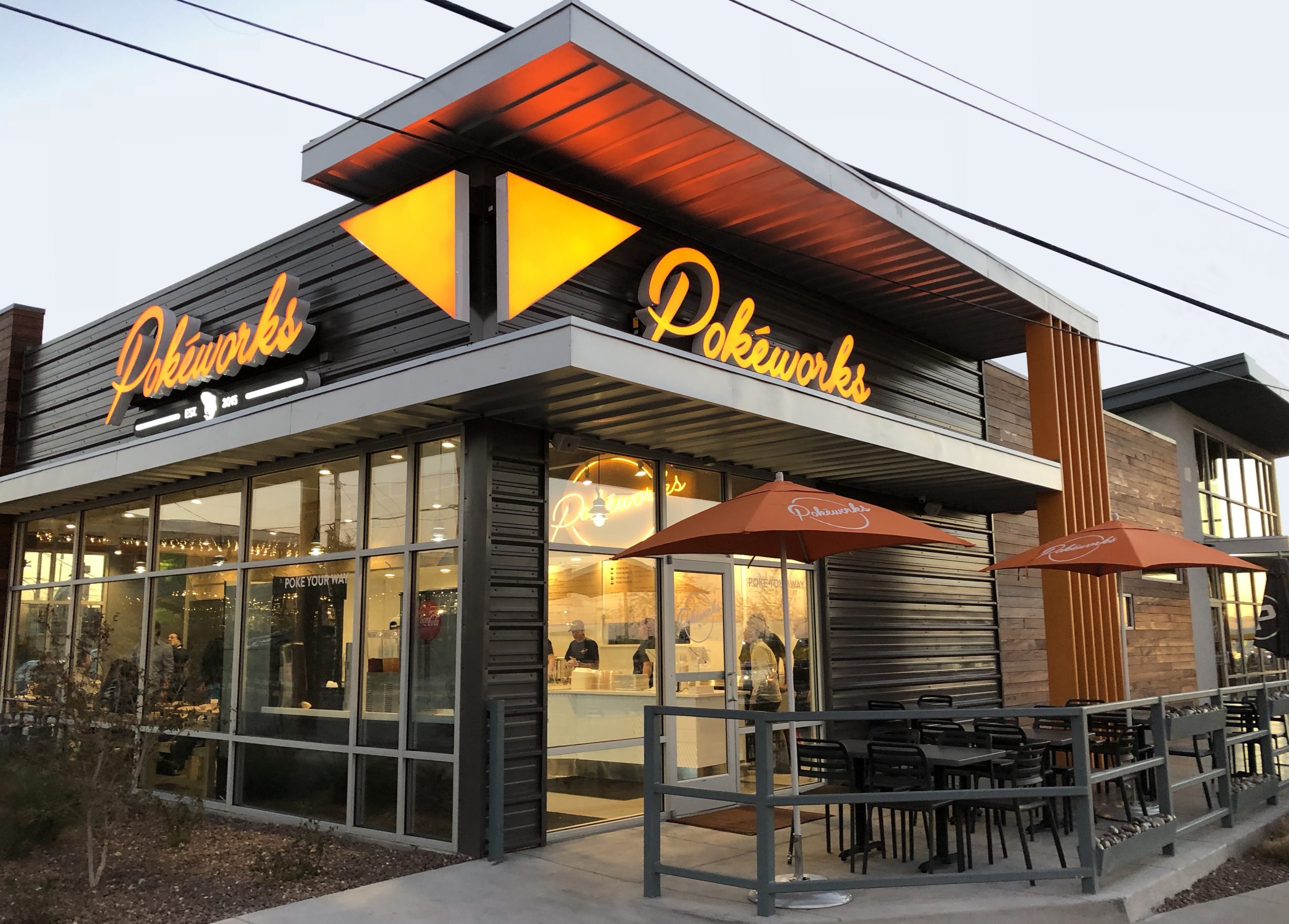
Finding the right location for a restaurant franchise has never been simple, but it has rarely been as consequential as it is today. Rents are elevated. Construction costs have climbed. Permitting timelines stretch in ways that eat into a franchisee’s runway before a single bowl is served. In that environment, the brands that grow well are the ones that have turned site selection into a discipline, not a checkbox.
Peter Yang, co-founder and head of development at Pokeworks, is one of those operators. Since founding the fast casual poke brand in 2015 with a group of friends, Yang has built an 80-unit footprint across street-side locations, kiosks, and nontraditional formats ranging from roughly 350 to 1,500 square feet. Along the way, he has developed a clear-eyed framework for how franchisors and franchisees should think about real estate: rigorously, patiently, and with both data and boots on the ground.
That framework is worth understanding closely, because the lessons Yang has learned apply well beyond poke.
A Tighter Market and What It Demands of Franchise Brands
The backdrop for any restaurant real estate conversation in 2025 and 2026 is a market that has not gotten easier. According to QSR Magazine, rising prices on land, rents, and borrowing, combined with longer construction lead times and persistent labor cost pressures, have made development more challenging for franchisees across the limited-service segment. Retail vacancy rates remain low, demand for quality space in suburban strip centers is strong, and getting an A-site at a rent that supports healthy unit economics requires real discipline.
“It is a tight market. Rents are higher, construction costs are higher, labor is higher in most markets. So we’re treading more carefully to really maximize the chance of success for our franchisees, making sure we don’t leave any rocks unturned when we go about our real estate search.”
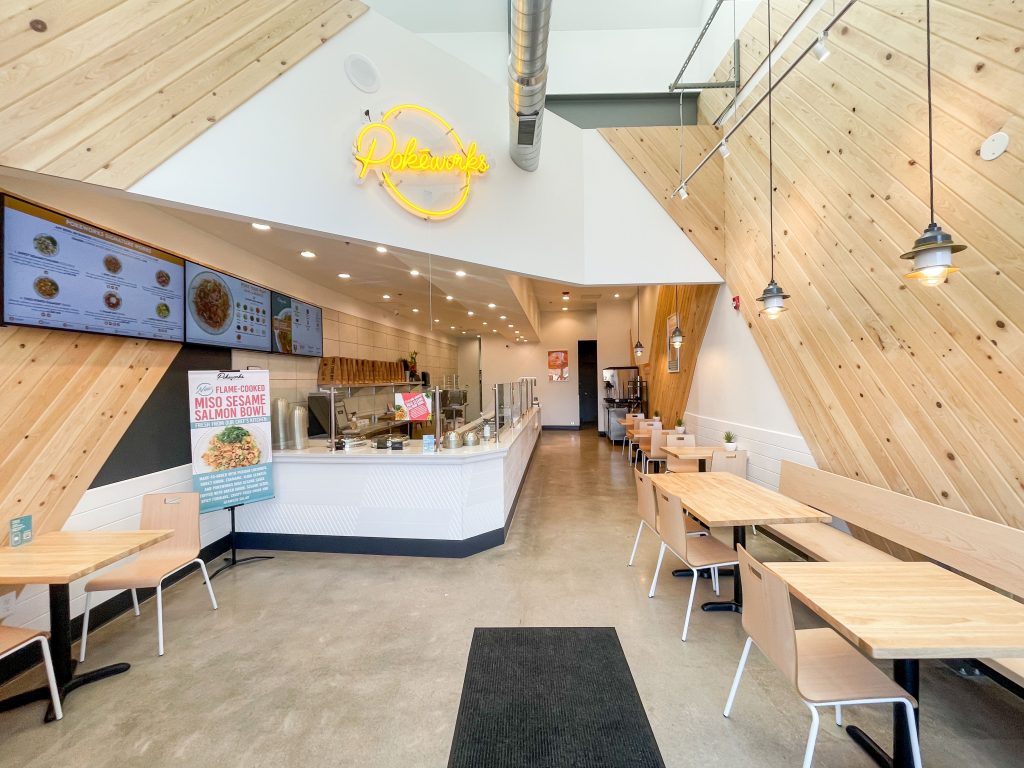
Unit economics, Yang says, is everything. A site gets evaluated on the rent it commands, the condition of the space, and what it will cost to build out. In that context, second-generation spaces have become especially appealing. When a prior food-and-beverage tenant has already installed infrastructure such as grease traps, ventilation, and plumbing, the savings on a Pokeworks buildout can range from 30 to 60 percent compared to a vanilla box, and the permitting timeline often compresses significantly.
That said, Yang is clear about the hierarchy. Second-generation savings do not override location quality. “The priority is still making sure there’s the right real estate,” he said. “We don’t want to take a space just because it’s a low build-out cost.” Cost efficiency follows real estate quality, not the other way around.
What the Ideal Fast Casual Location Actually Looks Like: Lessons From Pokeworks
Pokeworks’ site criteria offer a useful lens for any franchise brand in the limited-service space. Rather than chasing the lowest rent or the biggest space, the brand focuses on a handful of variables that consistently predict whether a location will perform. For prospective franchisees evaluating sites in any concept, these principles apply broadly.
Convenience is non-negotiable.
Fast casual works because it is fast, and fast means accessible. High visibility, easy turn-in and turn-out access, and minimal friction for a customer pulling off a main road matter more than square footage or interior finish. If someone has to think twice about how to get in or out of a center, many will simply keep driving.
Daytime population drives the lunch business.
Pokeworks runs roughly 60 percent lunch and 40 percent dinner. For any brand with a similar daypart split, proximity to office parks, business campuses, and dense daytime worker populations is a core site requirement. Trade areas that look residential-only on paper but have commercial corridors nearby are worth examining more closely.
Your neighbors are part of your brand positioning.
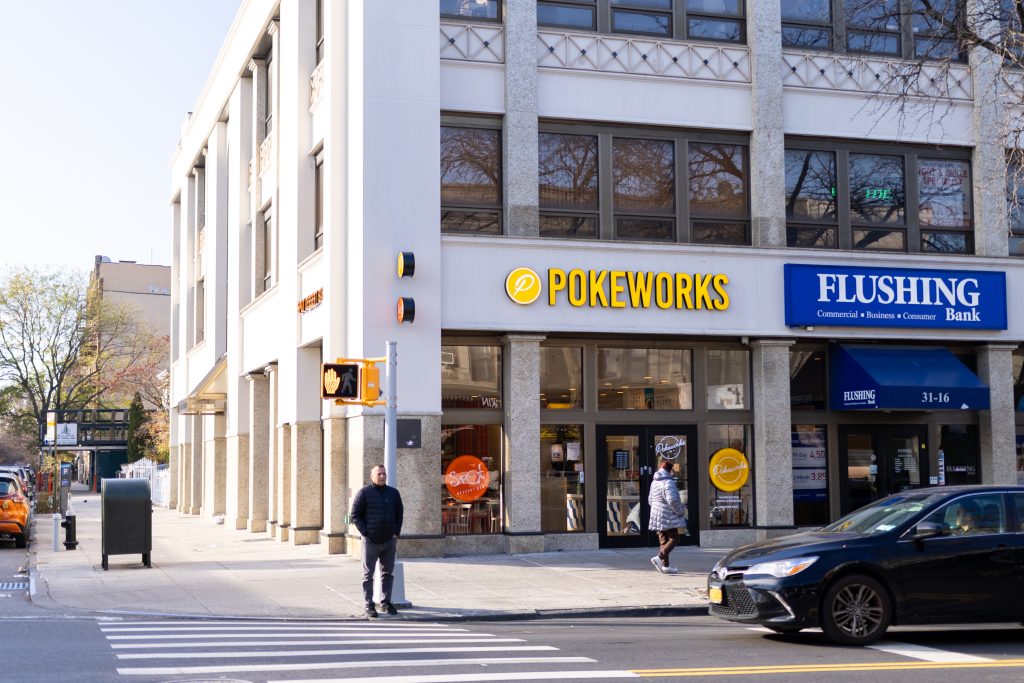
Pokeworks actively seeks co-tenancy with premium fast casual brands and fitness anchors. Large-format gyms like LA Fitness and Lifetime, as well as boutique fitness studios, draw the active, health-conscious demographic that is Pokeworks’ core customer. Yang is direct about it: “We’re really intentional about our neighbors. We want to be next to other premium fast casual brands who cater to that healthy, active lifestyle demographic and also gym fitness.” For franchisees evaluating a strip center, the tenant mix should be treated as a signal, not an afterthought.
Poor visibility costs you twice.
The first cost is the customer who drives past without noticing the location. The second is the marketing spend required to compensate. As Yang frames it: “You end up spending more marketing dollars to try to remind people that you’re there. You might as well put that towards occupancy.” A location with strong natural visibility reduces the ongoing cost of staying top of mind in a trade area.
Plan for delivery drivers as a customer class.
Pokeworks sees roughly 30 percent of its sales come through third-party delivery platforms. That volume requires convenient pickup parking, and the brand now includes a request for at least two short-term pickup spaces in its letter of intent template. A site that makes it difficult for drivers to stop and retrieve an order will see drivers declining assignments, which means lower ratings, lower reorder frequency, and lost revenue that is hard to trace back to a parking problem. Whether a brand is at 30 percent delivery or 10 percent, the direction of that metric means this consideration matters more every year.
Site-First Discipline: Half Science, Half Art
Pokeworks uses an internal scoring model to evaluate sites, a proprietary scorecard that converts qualitative site attributes into a numerical grade. As the brand’s unit count grows, that dataset enables stronger correlation studies to identify which variables most reliably predict long-term success. Yang is careful not to overstate what the data alone can do. “There’s no silver bullet,” he said.
The other half of the equation requires showing up in person. Yang visits every site before a lease is signed, accompanied by his real estate team. Data cannot fully capture the feel of a center, the actual flow of traffic at different times of day, or the quirks that numbers summarize but cannot explain. An intersection with strong average daily traffic figures might still create entry problems during school pickup hours. A center might look productive on mobility data but sit just around the bend from where consumers are actually moving.
“It’s half science and half art,” Yang said. “The art piece is actually going to the site, camping out with a clicker if you need to, and really feeling out the vibe of the center, the curb appeal of it, and how people are turning in, turning out, who’s actually going to it at what time.”
The site evaluation at Pokeworks is a trio decision involving the franchisor, the franchisee, and the broker. Each brings a different lens. Pokeworks brings data and brand standards. The franchisee, typically local to the area, contributes knowledge no dataset surfaces: traffic patterns during school hours, which intersections drivers avoid, and what makes a particular neighborhood behave differently than its demographics suggest. The broker supplies market relationships and pipeline visibility. All three visit the site, then come together to evaluate it. “We marry all of our knowledge together,” Yang said.
The Discipline of Saying No
Growth pressure is one of the more quietly corrosive forces in franchising. The impulse to hit a unit count, deliver on a development schedule, or satisfy a franchisee eager to open can push brands toward sites that look acceptable but are not actually right. Yang calls this selling yourself on a site, and it is something Pokeworks works actively to avoid.
Throughout the conversation, what comes through clearly is that Yang’s discipline around site selection is not abstract. It is personal. Every standard he describes comes back to the same concern: making sure the franchisee on the other end of the decision has a real shot at building something lasting.
“The discipline is to recognize that A sites will sell itself, and you should be excited to say, ‘Oh my God, I can’t wait to sign the lease and get going.’ That’s when you know you have a good site,” he said. “A lot of brands sometimes are pressured by growth, by unit count, to hit a certain unit count that they start selling themselves on sites.”
The alternative is a harder conversation to have later. Telling a franchisee to wait a few more months for the right space is manageable. Revisiting a 10-year lease that is not performing is not. “It might be hard to tell the franchisee, hey, we got to wait a little bit longer,” Yang said. “That’s a lot easier conversation to say, hey, you just signed a 10-year lease, it’s not going well, how do we unravel?”
Guiding Franchisees Through the Real Estate Process
Pokeworks franchisees arrive with varying levels of real estate experience. Some have operated multiple brands for decades and bring knowledge the franchisor can learn from. Others are navigating the process for the first time, needing guidance on everything from what an LOI is to what CAM charges mean for their long-term economics. Pokeworks adapts to the franchisee and treats the real estate process as a collaborative one throughout.
Every brand’s process will look different, but a few principles hold across concepts.
- Keep broker communication consistent. Regular scheduled calls, rather than ad hoc check-ins, keep the pipeline visible and prevent franchisees from making rushed decisions when a space suddenly becomes available.
- Stay involved through lease negotiation. Supporting franchisees through term review, rather than handing them off once a site is selected, meaningfully reduces the risk of a bad deal getting signed.
- Define the path to opening before day one. A clear construction and training timeline removes the anxiety that leads people to cut corners. At Pokeworks, that window from lease signing to opening runs four to six months, with permitting as the primary variable. The specific numbers will differ by brand, but the discipline of having a defined process is universal.
Lease Terms Worth Fighting For
Two lease provisions stand out as consistent priorities for Pokeworks. The first is option renewals. The brand negotiates for at least one five-year option, and ideally two. Locking in the right to extend on favorable terms protects the franchisee’s long-term investment and keeps a performing location from being disrupted at lease expiration.
The second is permit contingency. Permitting timelines vary dramatically by municipality. Pokeworks asks for free rent to begin after permits are received, not after lease execution, specifically to prevent franchisees from paying dark rent on a space that is not yet open. “That’s a wild card. It’s out of our hands. You can do everything right, and permitting alone can eat up all your free rent,” Yang said.
Operational Excellence Is What Makes a Good Site Worth It
For Yang, every real estate conversation ultimately leads to a second one that matters just as much. A great site without strong operations inside it is a wasted opportunity. A brand can select the most visible corner in the best trade area, execute a clean buildout, and still underperform if the experience inside the four walls does not deliver on the promise. Pokeworks has made operational excellence a central focus as the brand has matured, concentrating on hospitality standards, product consistency, and the value guests perceive from their visit. Consumer expectations around value have shifted. Guests spending fifteen dollars on a bowl expect more than portion size in return. They expect the team to be engaged, the environment to be on, and the overall experience to justify what they paid.
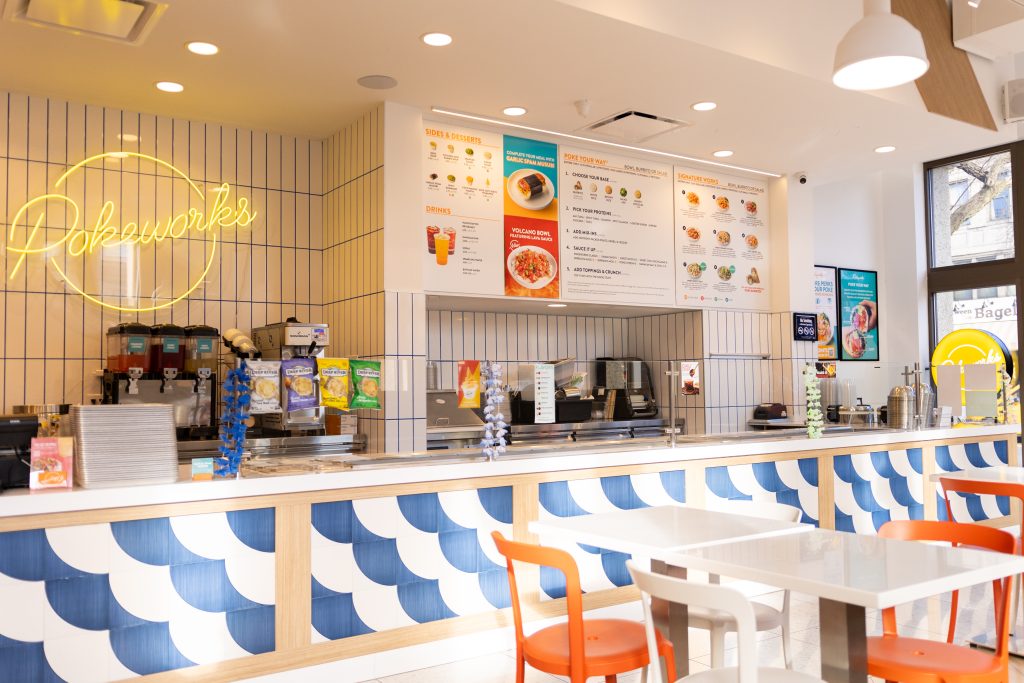
That emphasis reflects a broader lesson Yang draws from a decade of building the brand. Assuming that brand momentum will carry a location regardless of where it sits or how it operates is a trap. “The long-term sustainability of that is, in my opinion, through strong accessibility, clear visibility, and operational excellence,” he said. “You got to make sure you’re doing really well within the four walls. That’s actually more important than anything else.”
For any franchise brand navigating the current real estate environment, that pairing of site-first discipline and in-store commitment is the full picture. Finding the right four walls is hard enough. What happens inside them is what determines whether the investment was worth making.
