

Moving is rarely just a moving truck and a new address. For many families, the hardest part is not logistics. It’s the moment when a parent’s life changes, and the home that once felt stable becomes complicated, unsafe, or simply too much to manage.
Smooth Transitions exists for that moment. The brand’s work sits inside senior care and relocation, often described as senior move management, but the promise is simple: step in when a transition lands on the family, then carry the details with care.
As Richard Miller, Chief Development Officer at Smooth Transitions, put it, “Where we come in is we can remove that pain and stress from the family.” The pain he’s describing is rarely abstract. It’s a sudden medical need, a move into independent living, assisted living, or memory care, and a house full of decades that still has to be sorted, packed, and cleared, all while relationships and emotions run hot.
That is where Smooth Transitions wants to be useful. The brand’s value is operational, floor plans, packing systems, project management, and estate clearing, but it is also emotional by design. The mission that ties those pieces together is “same heart, new home,” a phrase that shapes how the company trains, hires, and shows up in living rooms across the country.
The Demand Drivers Behind Senior Move Management
Smooth Transitions positions the category inside a needs-based “care economy” lane. Life transitions still happen in strong economies and weak ones, and families tend to spend to protect loved ones when it matters most.
The industry has several indicators of long-term demand: a $30B+ senior relocation market growing at about 5.4% CAGR, more than 10,000 Americans turning 65 every day, and a reality that 90% of seniors prefer aging in place, which can increase the need for support when a transition eventually becomes necessary. The brand also highlights an adoption gap, noting that only about 1 in 10 families use professional help today, leaving significant white space for a service model built around guidance, speed, and emotional care.
That context helps explain why senior move management often feels invisible until it becomes urgent. The work is not driven by trends, it is driven by life stage, health, and family responsibility, which is exactly where Smooth Transitions has built its “same heart, new home” promise.
When a move becomes urgent, and when it becomes wise
Smooth Transitions sees familiar patterns in why people reach out, and those patterns explain why the service feels invisible until it suddenly becomes essential.
The first trigger is urgent: “mom’s not doing well,” Miller said, estimating that this accounts for about half of calls. In those situations, families are in crisis, trying to make decisions quickly, and often trying to keep daily life intact while a parent’s needs escalate.
The second trigger is quieter, but no less meaningful. Many seniors want “more independence and less complexity,” Miller explained, describing customers who are tired of managing repairs, tired of the ongoing maintenance cycle, and ready to downsize before a crisis forces their hand. He pointed to communities called CCRCs, continuing care retirement communities, where someone may move in once and then shift within the community as care needs change over time.
The third trigger is the least predictable. Some people are proactive. Some are dealing with unusual circumstances. But across all of it, the message Smooth Transitions wants families to hear is the one Miller attributes to the company’s founder: “Do it now while you’re in charge.”
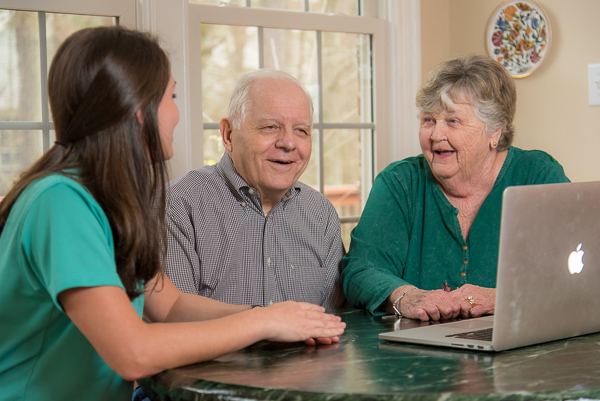
In many cases, the person making the call is the senior themselves. Miller estimated that about 70% of calls come directly from seniors, with the remaining share coming through attorneys, life care managers, therapists, or guardians, usually when the situation involves a higher level of care. Then comes the practical question families often ask, sometimes out loud and sometimes through hesitation: Why not just do it ourselves?
Smooth Transitions’ answer is not judgment. It’s scale. Miller described what he routinely sees: a long-time home filled with a lifetime of belongings, plus the leftover items adult children never reclaimed, plus family possessions stored from previous generations. In that context, even motivated families can feel overwhelmed.
He also described the difference between trying to muscle through the process alone and working within a repeatable system. A family’s move can take “six to eight months” to complete on their own, he said, while Smooth Transitions often completes the move and home clearing in “two to three weeks.”
That time gap is not just convenience. It can determine how quickly a family can put a home on the market, how smoothly a senior acclimates to a new environment, and how much emotional pressure accumulates along the way.
A founder’s foresight and a quality-first legacy
Smooth Transitions traces its roots to Louisville, Kentucky, where founder Barbara Morris started the company roughly 30+ years ago. Morris is someone who saw what was coming before most people did: an aging population, increasing complexity around senior transitions, and families who would need a professional, structured service to handle more than just the physical move.
Her early impact wasn’t limited to building a business. Morris was a founding member of NASMM, a professional ethics and continuing education group in the senior moving management space. What began with 12 members has grown to 1,000+ members.
Miller’s own entry point into Smooth Transitions began as an operator, not as a franchisor. Eight years ago, he and his team started a license under Morris after meeting her through someone at church. Training happened in her living room. He remembers being handed a thick manual and stepping into a system that worked, even if it was not yet optimized for modern operations.
Over time, that contrast became instructive. The company moved from paper processes and multiple disconnected tools to an integrated approach that lives on phones and tablets. But when Miller was asked what really endured from the earliest days, he did not point to the manual or the workflow. He pointed to a standard.
“Quality is probably the one word that stands out to me, quality of service,” he said, describing it as Morris’s core promise.
Today, Smooth Transitions positions “same heart, new home” as the modern expression of that same promise: take care of people, then build the system that makes care consistent.
The turnkey process that turns chaos into a “reveal”
Smooth Transitions often gets described as moving support, but the brand’s leaders talk about it as a full-turnkey transition, with the flexibility to deliver services a la carte when families only need part of the solution.
In practice, the work begins with a complimentary consultation. A team tours the home, explains services, and builds a plan around what the client wants and what the transition requires. The pricing is designed to be addressed early, at the kitchen table, with an emphasis on transparency.
“That quote is a binding will not exceed,” Miller said.
From there, Smooth Transitions executes through a four-step process that brings structure to what often feels like an unstructured life event.
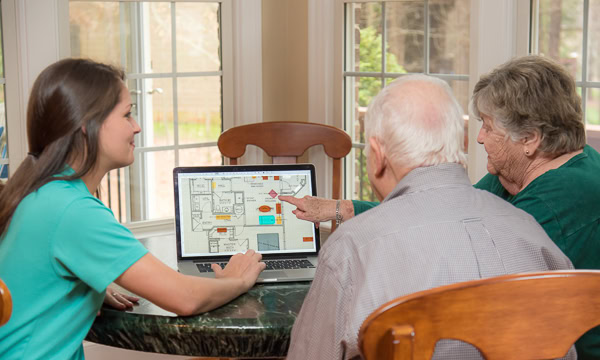
Step one focuses on planning and design. The team photographs the home, measures furniture, and creates a digital floor plan. The goal is to design the new space with the client, so the layout makes sense, mobility needs are considered, and the move does not become a cycle of repeated lifting and rearranging. “We only want to move things once,” Miller said.
Step two is the downsizing, packing, moving, and settling phase, and it begins with a mindset shift that Smooth Transitions treats as a form of emotional support. Downsizing can overwhelm anyone, especially when every object carries a story. The team works to keep attention on what stays, not what goes.
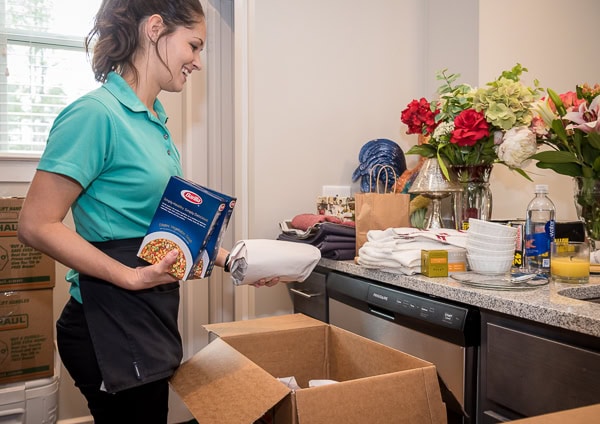
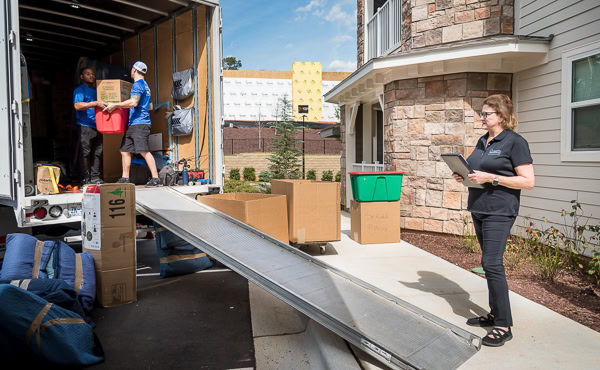
Move day itself is designed to reduce stress. Smooth Transitions encourages the client to leave for the day, doing something enjoyable, while the team handles the physical and logistical work. The team moves everything, unpacks, reassembles furniture, hangs pictures and TVs, connects electronics, makes beds, removes trash, and sets the home so it feels ready to live in, not ready to be worked on.
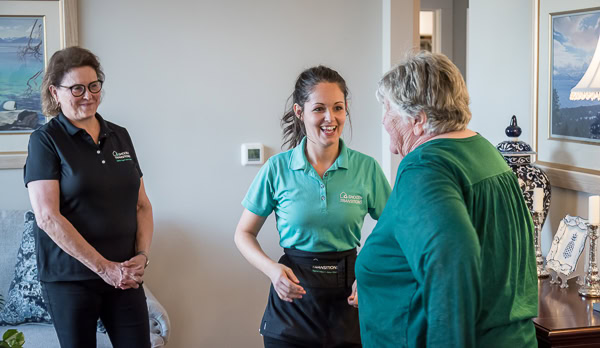
“Right around dinner time, we’ll call them, tell them, come on home,” he said. Then comes the moment Smooth Transitions treats as a signature: “it’s a reveal, much like you would see on HGTV. Move that bus!”
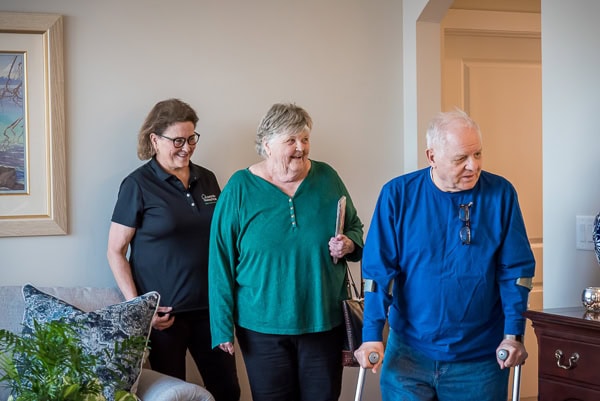
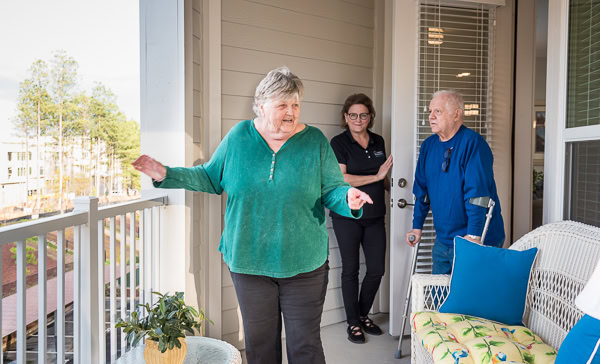
Steps three and four bring closure to the home left behind. Smooth Transitions returns about a week later to sort remaining items, identify what is sellable, what should be donated, and what must be disposed of, then leave the property “empty and in broomswept condition.” The final step is proof and relief: the team photographs the finished home and emails the images to the client, who may already be settled in their new community and may not want to return to the house at all.
The full process is built to solve a common family problem: the move is only half the burden. The rest lives in the home, and the emotional weight of what remains.
Protecting emotional health, not just moving boxes
Smooth Transitions does not talk about empathy as a soft add-on. In Miller’s telling, emotional protection is part of the job, because the move itself can trigger fear, grief, and a sense of lost control.
“We protect our people’s emotional health,” he said, describing how seniors can feel like they are losing autonomy during the transition.
That focus shows up in training and in hiring. When asked whether the company trains for grief, conflict, sibling dynamics, and resistance to letting go, Miller’s answer was direct: “100% yes, from end to end.” He described repeating patterns, coaching on how to work with memory care challenges, and the importance of recognizing what to do, and what not to do, to keep a client emotionally steady.
One of his clearest examples is also one of his most personal. Before owning the business, Miller helped move his mother-in-law, believing he was doing the right thing. After the move, he watched as most of her belongings were thrown into a dumpster in her driveway. It felt practical at the time, but in hindsight he sees it as avoidable harm.
“I would never today do that to a client,” he said. “I would never let them see their stuff go into a dumpster.”
The detail matters because seniors often experience a move as more than a change of address. It can feel like a loss of identity, and the wrong moment can make the transition feel like a disposal.
Heart of the home
That is also why Smooth Transitions invests in learning the “heart of the home.” A practice that sounds operational, but is rooted in dignity: photographing a home “in its natural state,” studying what sits within reach of a favorite chair, what belongs on the nightstand, and what small items help someone feel oriented when they wake up in the dark.

He shared a story that captures the concept. A client had a small brooch, a gift from her husband Ken on their first date “50 plus years prior.” Ken had passed away, and the brooch became a quiet source of comfort.
“When she misses Ken, she rubs it like a worry stone,” Miller said, describing the brooch as the true heart of that client’s home.
Then there is the story that, in many ways, feels like Smooth Transitions in a single scene.
During an early move, a leader on Miller’s team, Karen Wellspeak, noticed a couple’s daily ritual: every morning, they watched the sunrise with coffee. On move day, Wellspeak drove early, photographed the sunrise, printed and framed it, and placed it on the kitchen wall of the new home. The next morning, coffee still came with sunrise.
“She moved the sunrise,” Miller said.
Smooth Transitions treats those details as part of the system, not a lucky accident. Training can teach process, but the brand’s leaders also emphasize something less teachable: a “servant’s heart,” and the instinct to care without being prompted.
From licensing to franchising, and what changed
Before franchising, Smooth Transitions expanded through licensing. When Miller’s team purchased the brand, he said there were 29 licenses across 26 states.
Over time, the leadership group came to see a structural problem: the licensing framework limited how much support they could safely provide. The more they wanted to help operators, the more the model constrained them. The tipping point came through repeated feedback. Operators kept asking a simple question: if the brand has a proven process, “why is this not a franchise?”
Franchising, for Smooth Transitions, is positioned as a mechanism for deeper support and consistency. Miller described eight licensees converting to franchisees because “they saw the value, they wanted the help,” and believed the structure would help them reach “the next level.”
Today Smooth Transitions is owned by Richard, Brian and Holly who all work within the brand.
The franchise model, designed in two lanes
Smooth Transitions is a people-first brand, but it is also a process-first business. One of the ways the franchisor tries to make the work doable is by clarifying roles early, so new owners do not default to doing everything at once. In Miller’s description, the model is organized into two lanes: a director of operations and a director of market development. Within a couples team, the goal is separation of duties. In other cases, an owner may hire for one lane and focus on the other.
Market development is built around education and trust. It includes networking, one-on-one relationship building, and steady community presence, supported by what the brand describes as a tech stack that runs in the background. Once traction builds, that visibility becomes consultations and scheduled work. Operations is the daily delivery: floor planning, downsizing, packing, moving, unpacking, and coordinating estate-related services. The day-to-day work varies because each client’s home and needs vary, but the lanes stay consistent.
The staffing model reflects that flexibility. Smooth Transitions can start as a home-based business. Miller said new owners can begin with “two to four people,” then stabilize and backfill positions as the business grows. He also described a busy season, noting that “in the summer is when most people move, even seniors,” and framing May through August as a period when teams often scale with seasonal help.
Marketing, STware, and the systems behind local execution
Garret Hinojosa, Smooth Transitions’ Director of Franchise Development and Marketing, describes the brand’s growth engine as a mix of local presence and centralized support. The work is relationship-driven, but it still needs a repeatable marketing system that helps owners build awareness before they walk into their first referral meeting.
Hinojosa described an “omnichannel approach” that begins with a prelaunch phase and a “really defined 90 day go to market strategy.” The plan includes building social presence, setting up Google microsites for each location, and launching early awareness campaigns aimed at both adult children and referral sources.
He emphasized a reality that many service brands learn the hard way: local referral relationships often do not open through digital marketing alone. Assisted living communities, memory care centers, and independent living communities usually require in-person touch. Smooth Transitions’ approach is to combine on-the-ground presence with digital reinforcement and retargeting, so referral sources see the brand before they meet the owner, then keep seeing it afterward.
STware
Technology is designed to support that system, not distract from it. The company’s in-house platform is called STware, and is proprietary to the brand. It’s not a reskinned platform; rather they built it from the ground up.
Miller described the philosophy behind the platform in plain terms: it was “built with the mentality of Fisher-Price, we wanted it to be simple, easy, and everything to work together.”
That simplicity matters because Smooth Transitions came from a world where systems were scattered. The business previously requiring 13 different applications to run. Today, those tools are housed within the software framework, supporting scheduling, operations, and visibility across the business.

Hinojosa also described the company building its playbook on operating history and data, saying the team has “30 years worth of data” and conversion benchmarks that inform how they coach outreach and lead flow. And in one quote that captures the franchising mindset behind Smooth Transitions, he shared a line he heard at a conference: “a good franchise system should be built in a way where an average person on a normal day can put forth an average amount of effort and see predictable outcomes.”
It is an operational philosophy, but it also mirrors the brand promise. Smooth Transitions is trying to make a difficult life moment feel manageable for families. It applies the same principle to owners: simplify the system, so care and consistency have room to show up.
Who fits Smooth Transitions, and what the brand wants to protect as it grows
Smooth Transitions is not positioned as a business built for someone who wants to stay behind a desk. The model is relationship-first. It requires local trust. And it benefits from owners who can manage people, projects, and emotions without treating any of them like an inconvenience.
Hinojosa described the ideal owner as a “service first operator,” someone with project management instincts, business acuity, and a relationship-building mindset. He emphasized coachability, and the importance of embracing the system rather than resisting it.
He also offered a perspective that widens the aperture on what qualifies as project management. The skill can come from managing teams, managing families, or managing complex environments. He pointed to a franchise candidate who had been a private school principal, describing that background as relevant because it requires managing different stakeholders with different expectations.
For prospective owners, the brand invites candidates to see the business up close. Discovery Day is designed as an on-site experience at the headquarters location in Westerville, Ohio, in the Columbus market, where candidates can see training spaces, operational setups, and what ownership could look like over the long term.
Through all of these mechanics, ideal markets, marketing systems, and software, Smooth Transitions’ leaders keep circling back to one thing they want franchising to preserve: the humanity of the work.
Miller described two surprises that came from building in this category. The first is community, the way owners and operators form relationships that last, largely because “you just naturally gravitate towards people that love to help people.”
The second is meaning. The work is hard, he acknowledged, but “you are making a difference,” and that impact, in his words, “feeds your soul.”
The brand’s aim is clear. As it shifts from licensing to franchising, Smooth Transitions is scaling a repeatable process without losing the small moments that define the experience, a home set up before dinner, a brooch placed within reach, and a sunrise that still shows up in the right place.
